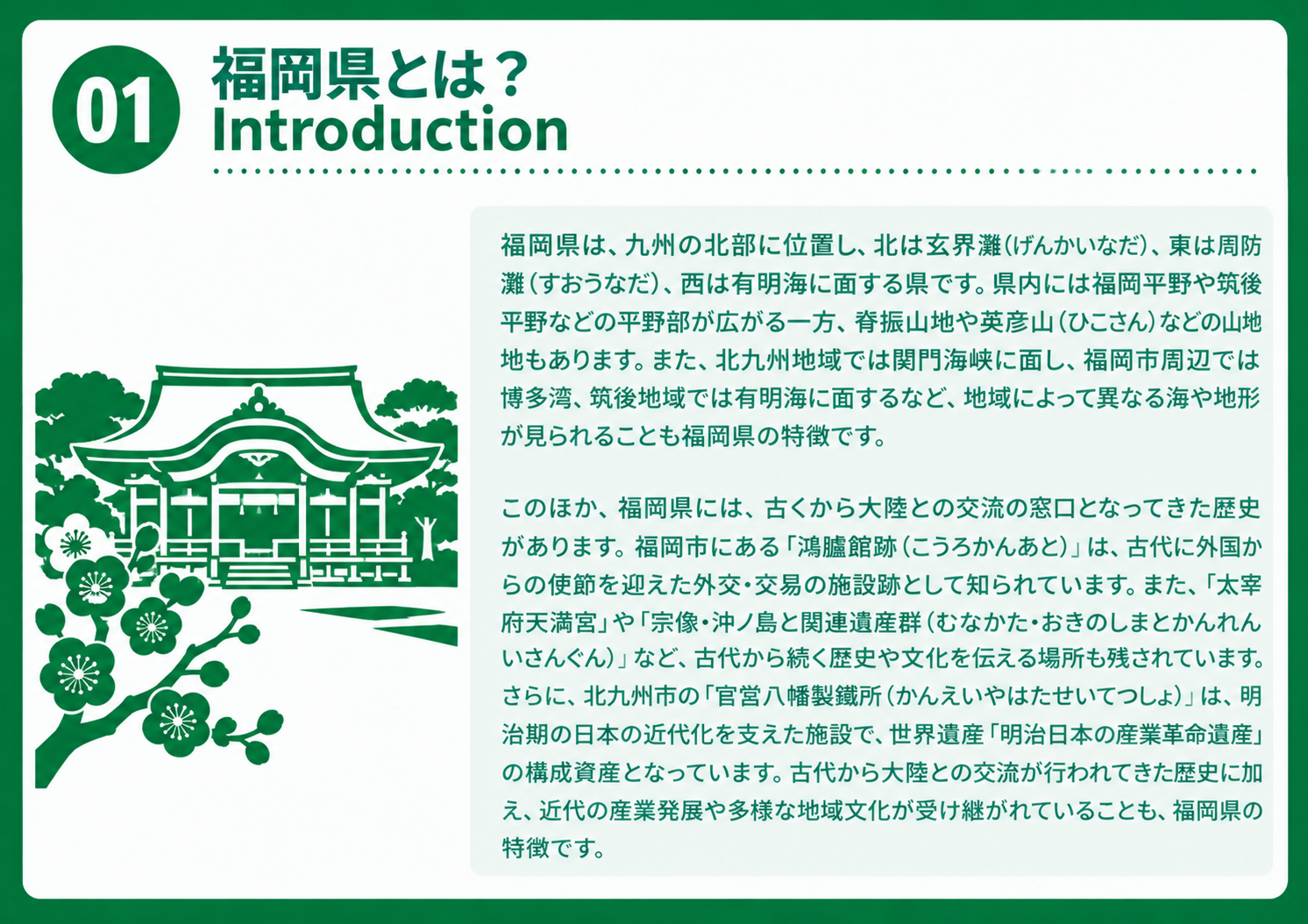
01:福岡県とは?/Introduction
Fukuoka Prefecture is located in northern Kyushu and is bordered by three different seas: the Genkai-nada Sea to the north, the Suo-nada Sea to the east, and the Ariake Sea to the west. The prefecture features expansive plains, including the Fukuoka and Chikugo Plains, as well as mountainous areas such as the Sefuri Mountains and Mount Hiko. Its diverse geography also includes distinct coastal areas: the Kitakyushu region faces the Kanmon Strait, the area around Fukuoka City faces Hakata Bay, and the Chikugo region borders the Ariake Sea.
Fukuoka Prefecture also has a long history as a gateway for exchanges with the Asian continent. The “Site of the Kōrokan” in Fukuoka City is known as the remains of an ancient diplomatic and trading facility where envoys from overseas were received. Other sites that preserve the region’s history and cultural heritage include “Dazaifu Tenmangu Shrine” and the UNECO World Heritage Site, “Sacred Island of Okinoshima and Associated Sites in the Munakata Region.” In addition, the Imperial Steel Works, Japan, in Kitakyushu City, played an important role in Japan’s modernization during the Meiji period (1868-1912). It is one of the component sites of the World Heritage property known as “Sites of Japan’s Meiji Industrial Revolution: Iron and Steel, Shipbuilding and Coal Mining.” Fukuoka Prefecture is characterized by its long history of exchange with Asian continent, its legacy of modern industrial development, and the rich diversity of its regional cultures.
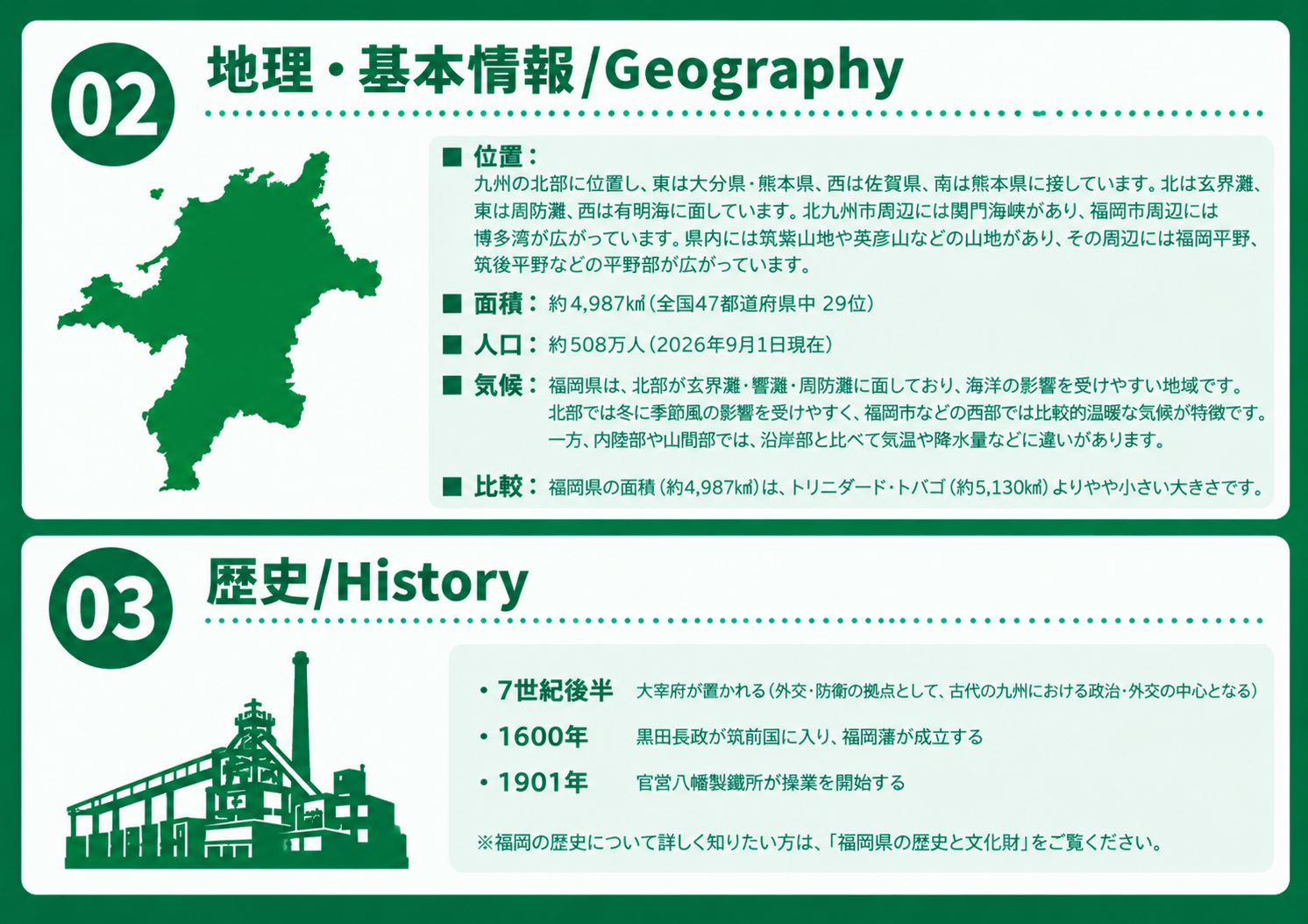
02:地理・基本情報/Geography
・ Location:Fukuoka Prefecture is located in northern Kyushu. It borders Oita and Kumamoto prefectures to the east, Saga Prefecture to the west, and Kumamoto Prefecture to the south. It faces the Genkai-nada Sea to the north, the Suo-nada Sea to the east, and the Ariake Sea to the west. The Kanmon Strait lies near Kitakyushu City, while Hakata Bay is located near Fukuoka City. The prefecture has mountainous areas, including the Chikushi Mountains and Mount Hiko, as well as plains such as the Fukuoka Plain and the Chikugo Plain.
・ Area:Approximately 4,987 km² (29th largest among Japan’s 47 prefectures)
・ Population:Approximately 5.08 million (as of September 1, 2026)
・ Climate:The northern part of Fukuoka Prefecture faces the Genkai-nada Sea, Hibiki -nada Sea, and Suo-nada Sea, and is therefore strongly influenced by the surrounding seas. In the north, the climate is affected by seasonal winds in winter, while the western part, including Fukuoka City, generally has a relatively mild climate. On the other hand, inland and mountainous areas differ from coastal areas in terms of temperature and precipitation.
・Size Comparison:Fukuoka Prefecture’s area (approximately 4,987 km²) is slightly smaller than Republic of Trinidad and Tobago(approximately 5,130 km²).
03:歴史/History
・Late 7th century:Dazaifu was established (as a political, diplomatic, and military center of ancient Kyushu, serving as a base for foreign relations and defense.)
・1600:Kuroda Nagamasa became lord of Chikuzen Province, making the beginning of the Fukuoka Domain.
・1901:The government-run Yawata Steel Works began operations.
*For those interested in learning more about the history of Fukuoka, please visit the “GO FUKUOKA : History & Culture”
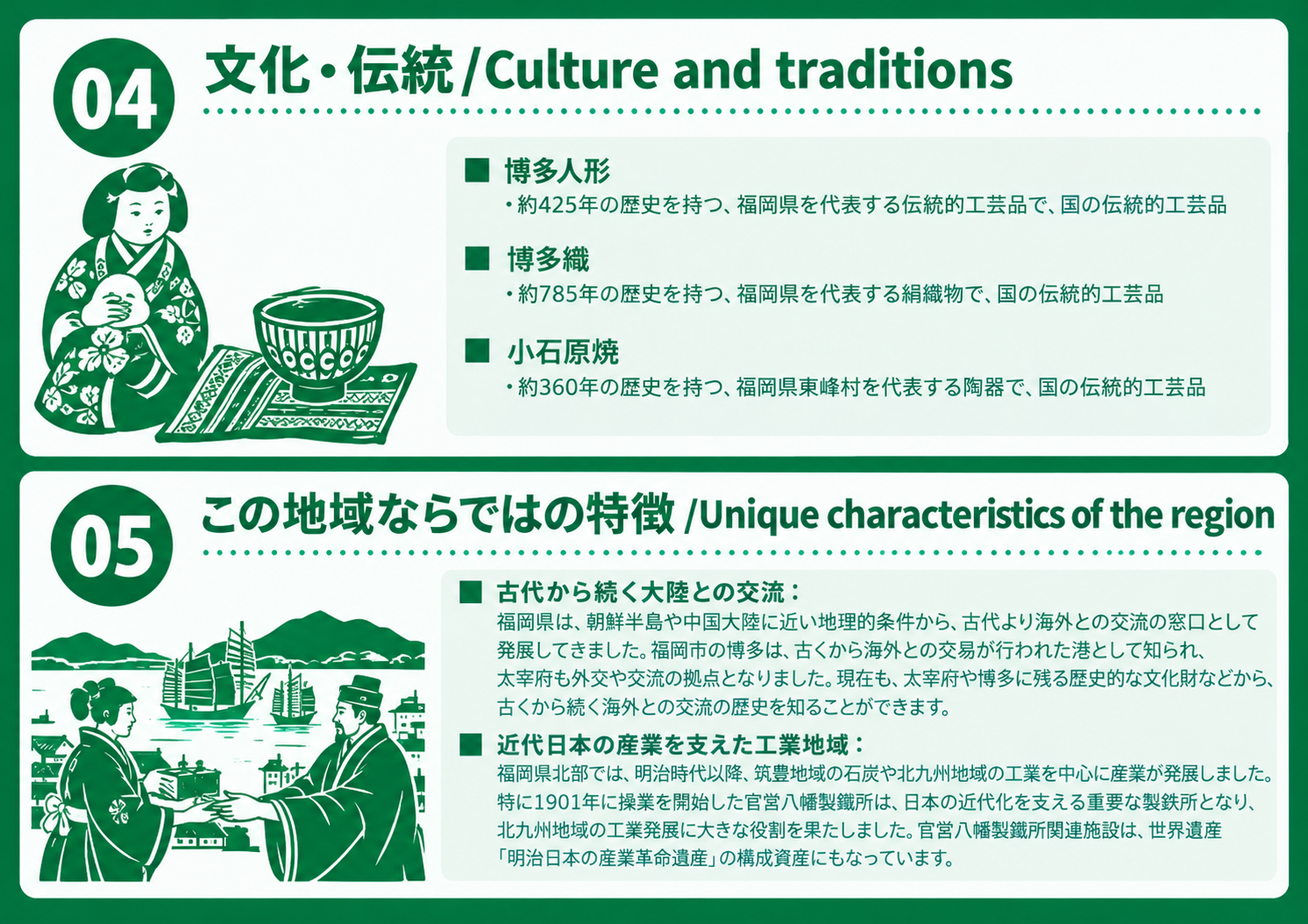
04:文化・伝統/Culture and traditions
• 博多人形 / Hakata Dolls : A traditional craft from Fukuoka Prefecture with a history of approximately 425 years. Hakata Dolls are designated as a traditional craft by the Japanese government.
・博多織 / Hakata-ori Textiles : Traditional silk textiles from Fukuoka Prefecture with a history of approximately 785 years. Hakata-ori is designated as a traditional craft by the Japanese government.
・小石原焼 / Koishiwara Ware (Pottery) : Traditional pottery from Toho Village in Fukuoka Prefecture with a history of approximately 360 years. Koishiwara Ware is designated as a traditional craft by the Japanese government.
05:この地域ならではの特徴/Unique characteristics of the region
• Exchanges with the Asian Continent Since Ancient Times:
Because of its geographical proximity to the Korean Peninsula and mainland China, Fukuoka Prefecture has served as a gateway for exchanges with other countries since ancient times.
Hakata, in Fukuoka City, has long been known as a port for overseas trade, while Dazaifu served as a center for diplomacy and international exchange. Today, historical sites and cultural heritage preserved in Dazaifu and Hakata offer insights into the region’s long history of international exchange.
• An Industrial Region That Supported Japan’s Modernization:
Since the Meiji period, industry in northern Fukuoka Prefecture has developed around coal mining in the Chikuho region and manufacturing in the Kitakyushu region. In particular, the government-run Yawata Steel Works, which began operations in 1901, became an important steelwork supporting Japan’s modernization and played a major role in the industrial development of the Kitakyushu region. Facilities associated with the government-run Yawata Steel Works are among the component sites of the UNESCO World Heritage site, “Sites of Japan’s Meiji Industrial Revolution.”
06:世界とのつながり・異文化比較/Global connections and cross-cultural comparisons
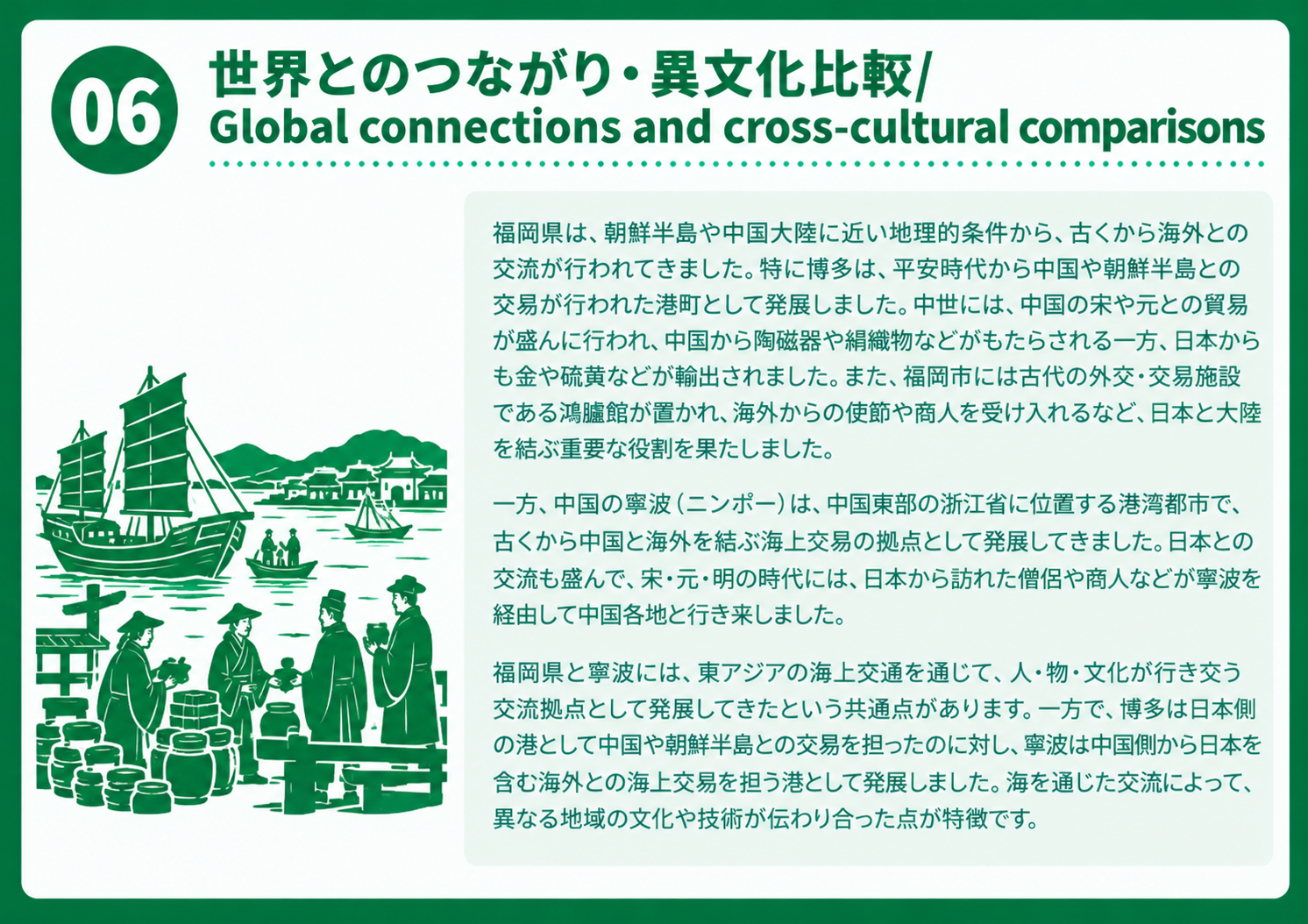
Due to its geographical proximity to the Korean Peninsula and mainland China, Fukuoka Prefecture has long engaged in international exchange. Hakata, in particular, developed as a port town where trade with China and the Korean Peninsula took place as early as the Heian period. During the Middle Ages, trade with China’s Song and Yuan dynasties flourished. While ceramics and silk textiles were imported from China, Japan exported goods such as gold and sulfur. Additionally, Fukuoka City was home to the Kōrokan, an ancient diplomatic and trade facility that played a vital role in connecting Japan with the mainland by hosting foreign envoys and merchants.
Meanwhile, Ningbo, China, is a port city located in Zhejiang Province in eastern China that has long flourished as a hub for maritime trade connecting China with the rest of the world. Exchanges with Japan were also active; during the Song, Yuan, and Ming dynasties, Japanese monks and merchants traveled to and from various parts of China via Ningbo.
Fukuoka Prefecture and Ningbo share a common history as hubs of exchange where people, goods, and culture flowed through East Asian maritime trade. However, while Hakata served as a Japanese port for trade with China and the Korean Peninsula, Ningbo developed as a Chinese port for maritime trade with overseas regions, including Japan. A defining feature of these exchanges was the transmission of culture and technology between different regions through maritime trade.
07:地域のマナー・ルール/Local manners and customs
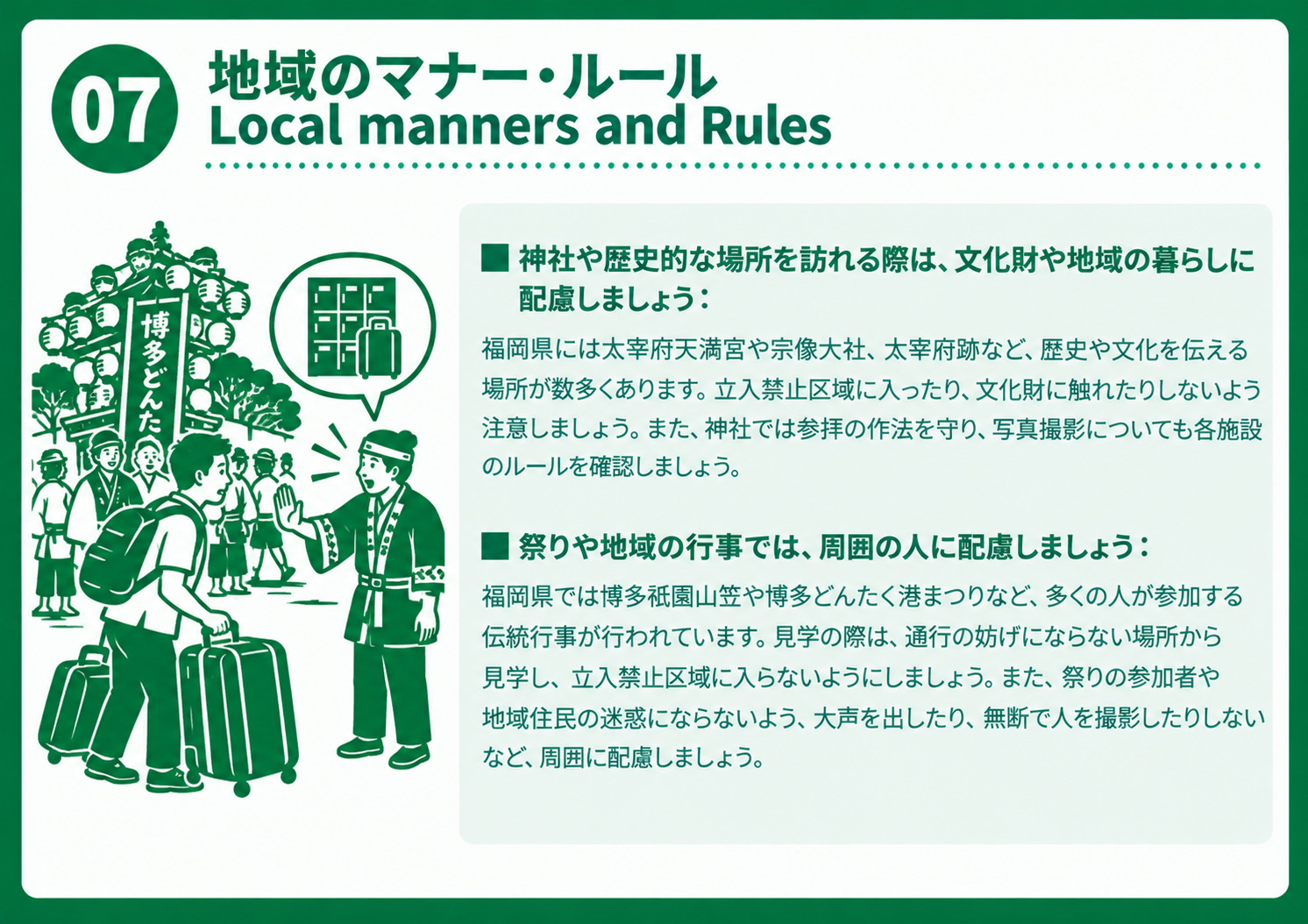
■ When visiting shrines and historical sites, please respect cultural heritage and the local way of life:
Fukuoka Prefecture is home to many sites that reflect its history and culture, including Dazaifu Tenmangu Shrine, Munakata Taisha Shrine, and the Dazaifu Government Office Ruins. Please do not enter restricted areas or touch cultural properties. At shrines, please observe proper worship etiquette and check each site’s rules regarding photography.
■ Be considerate of others at festivals and local events:
Fukuoka Prefecture hosts many traditional events that attract large crowds, including Hakata Gion Yamakasa and the Hakata Dontaku Port Festival. When watching these events, please choose a spot that does not obstruct the flow of people or traffic, and do not enter restricted areas. Please also be considerate of festival participants and local residents by avoiding loud behavior and refraining from taking photos of people without their permission.
08:祭・伝統行事/Festivals and traditional events
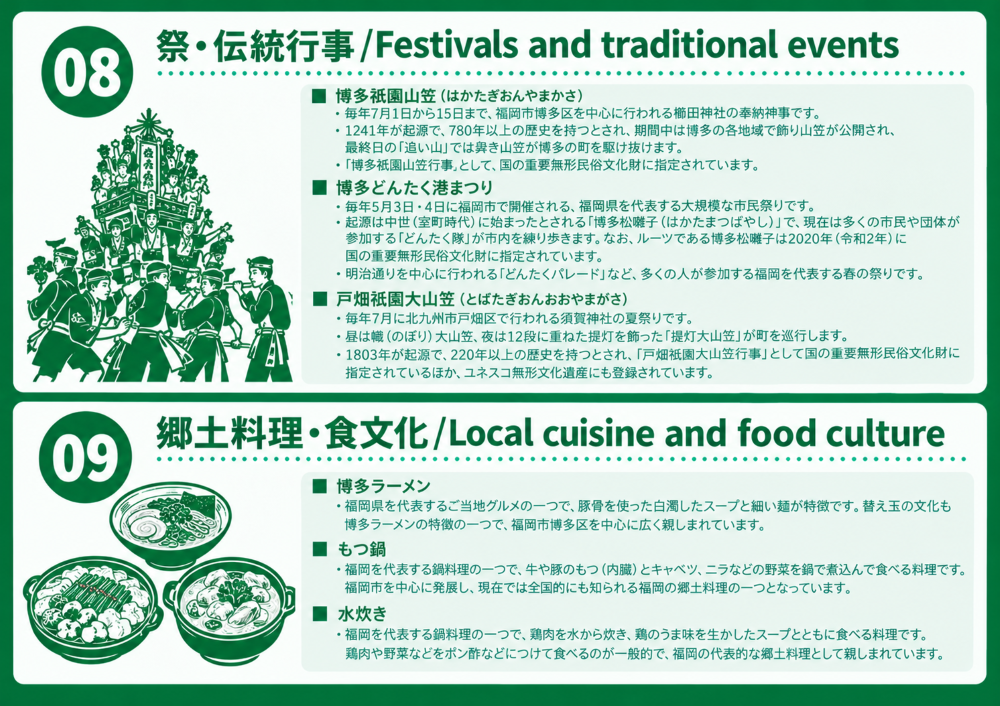
■ 博多祇園山笠(はかたぎおんやまかさ) / Hakata Gion Yamakasa
• This is a ritual dedicated to Kushida Shrine, held annually from July 1 to 15, mainly in Hakata Ward, Fukuoka City.
• Dating back to 1241, the festival is said to have a history of more than 780 years. During the festival, decorated Yamakasa floats are displayed in various areas of Hakata. On the final day, the “Oi-yama” race takes place, with teams carrying Yamakasa floats through the streets of Hakata.
• The festival is designated as an Important Intangible Folk Cultural Property of Japan under the name “Hakata Gion Yamakasa Festival.”
■ 博多どんたく港まつり / Hakata Dontaku Port Festival
• Held annually on May 3 and 4 in Fukuoka City, this is one of Fukuoka Prefecture’s major civic festival.
• Its origins lie in “Hakata Matsubayashi,” a traditional event dating back to the Middle Ages (Muromachi period). Today, groups known as “Dontaku troupes,” made up of local residents and organizations, parade through the city. Hakata Matsubayashi, the tradition from which the festival developed, was designated as an Important Intangible Folk Cultural Property of Japan in 2020.
• The festival is one of Fukuoka’s best-known spring events and features large-scale celebrations, including the he “Dontaku Parade” along Meiji-dori.
■ 戸畑祇園大山笠(とばたぎおんおおやまがさ) / Tobata Gion Oyamagasa
• This is the summer festival held every July in Tobata Ward, Kitakyushu City, in connection with Suga Shrine.
• During the day, banner-adorned floats known as “Nobori Oyamagasa” parade through the town. At night, the spectacular “Chōchin Oyamagasa,” decorated with 12 tiers of lanterns, take to the streets.
• Dating back to 1803, the festival is said to have a history of over 220 years. It is designated as an Important Intangible Folk Cultural Property of Japan under the name “Tobata Gion Oyamagasa Event” and is also inscribed on UNESCO’s Representative List of the Intangible Cultural Heritage of Humanity.
09:郷土料理・食文化/Local cuisine and food culture
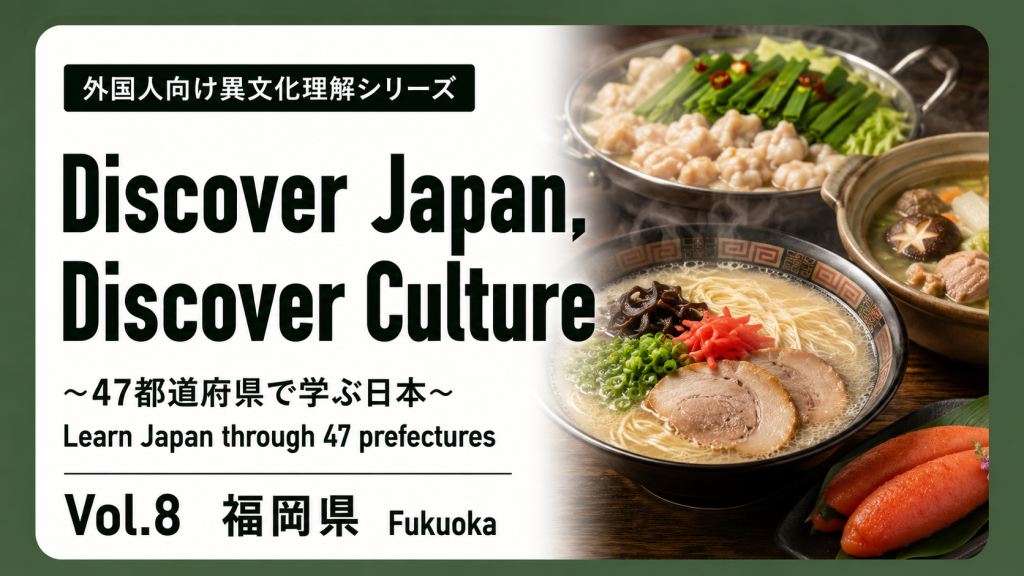
■ 博多ラーメン / Hakata Ramen:
One of Fukuoka Prefecture’s signature local dishes, Hakata ramen is characterized by a rich, milky-white pork bone broth and thin noodles. The custom of ordering extra noodles (“kaedama”) is another hallmark of Hakata ramen, which is widely enjoyed throughout Fukuoka, particularly in Hakata Ward, Fukuoka City.
■ もつ鍋 / Motsunabe:
One of Fukuoka’s signature hot pot dishes, Motsunabe consists of beef or pork offal simmered with vegetables such as cabbage and Chinese chives. It originated in Fukuoka City and has since become one of Fukuoka’s best-known regional dishes, recognized nationwide.
■ 水炊き / Mizutaki:
One of Fukuoka’s signature hot pot dishes, Mizutaki is made by simmering chicken in water from the start, creating a broth that brings out the chicken’s natural umami. The chicken and vegetables are typically dipped in ponzu sauce before eating. Mizutaki is widely enjoyed as one of Fukuoka’s signature local dishes.
10:公式情報・外国人向け情報/Official information and resources for international residents
■福岡県公式ホームページ / Fukuoka Prefecture Official Website
■福岡県国際交流センター / Fukuoka International Exchange Foundation
■FUKUOKA IS OPENセンター / Life and Work Support Center for International Residents
This article has been prepared by our staff based on official information provided by the Fukuoka Prefectural Government, the Agency for Cultural Affairs, the Japan Tourism Agency, and other official sources. The information in this article is based on information available at time of publication. For the latest information, please refer to the relevant official websites.
クロスザボーダー編集部
日本在住の全ての外国人のために様々な有益な情報をまとめたサイトをオープンしました。アルバイトや就職情報はもちろんのこと、日本での生活の安定・安心・安全に繋がる基盤情報や、より日本での生活を充実してもらうようための様々な情報を提供しております。一つでも多くの有益な情報を提供することで、皆さんの選択肢が増え、より豊かな日本での生活を送ってもらうことをサポートいたします。
https://www.crosstheborder.biz/