01:佐賀県とは?/Introduction
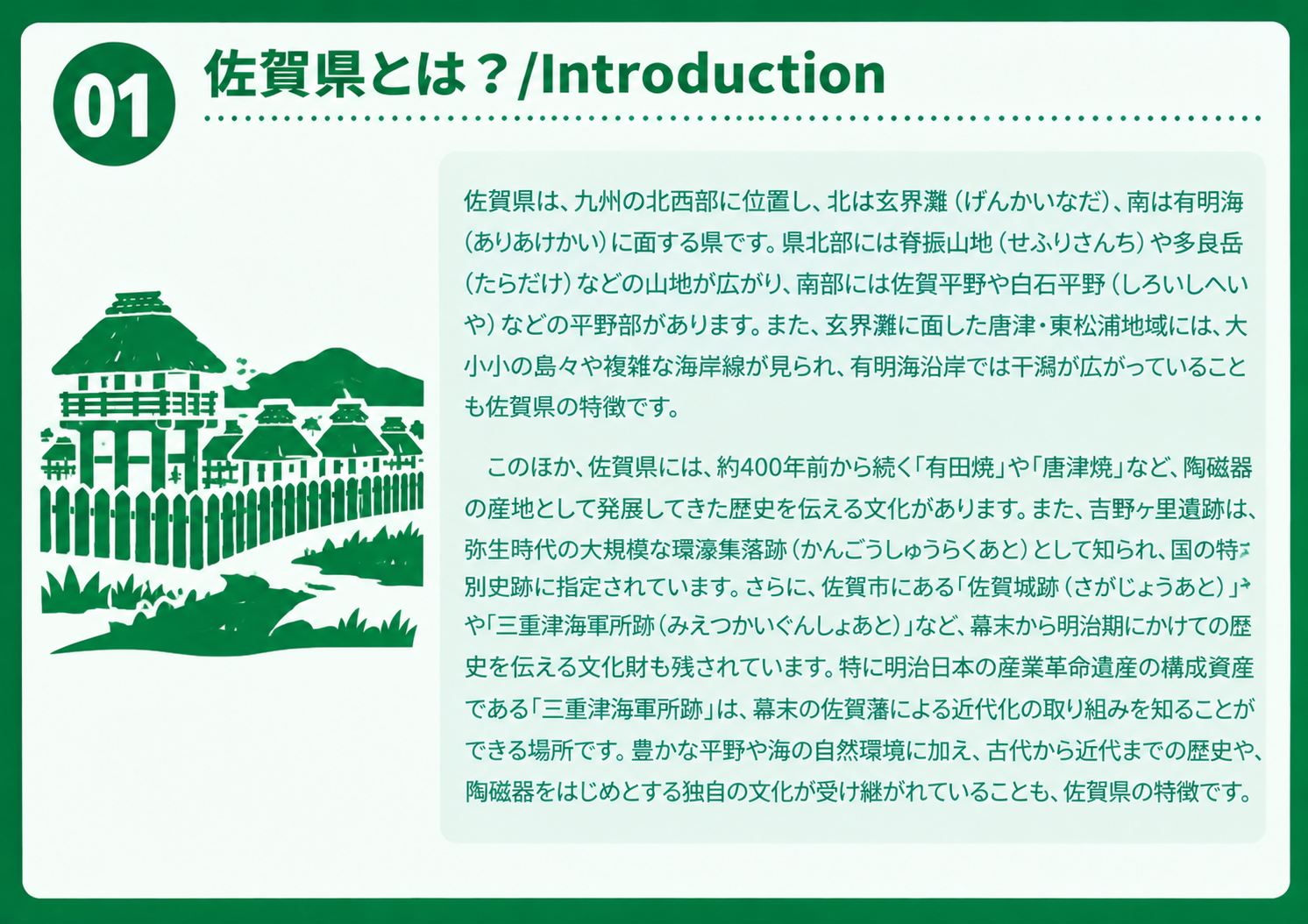
Saga Prefecture is located in the northwestern part of Kyushu, facing the Genkai Sea to the north and the Ariake Sea to the south. The northern part of the prefecture has mountainous areas, including the Sefuri Mountains and Mount Tara, while the southern part features plains such as the Saga Plain and the Shiroishi Plain. The Karatsu and Higashimatsuura regions, which face the Genkai Sea, are characterized by numerous islands of various sizes and a complex coastline. The coast of the Ariake Sea is also known for its expansive tidal flats. These geographical features are among the distinctive characteristics of Saga Prefecture.
Saga Prefecture also has a rich cultural heritage reflecting its history as a center for ceramics production, including “Arita-yaki” and “Karatsu-yaki,” traditions dating back approximately 400 years. The Yoshinogari Archaeological Site is known as the remains of a large-scale moated settlement from the Yayoi period and is designated as a Special National Historic Site. The prefecture is also home to cultural properties that preserve its history from the late Edo period through the Meiji era, including the ruins of “Saga Castle” and the “Miezu Naval Dock” in Saga City. In particular, the “Miezu Naval Dock,” a component site of Sites of Japan’s Meiji Industrial Revolution, offers insight into the Saga Domain’s efforts to modernize during the late Edo period. In addition to its rich natural environment, including its plains and coastal areas, Saga Prefecture is distinguished by its history spanning from ancient to modern times and its distinctive cultural traditions, including ceramics, which have been passed down through the generations.
02:地理・基本情報/Geography
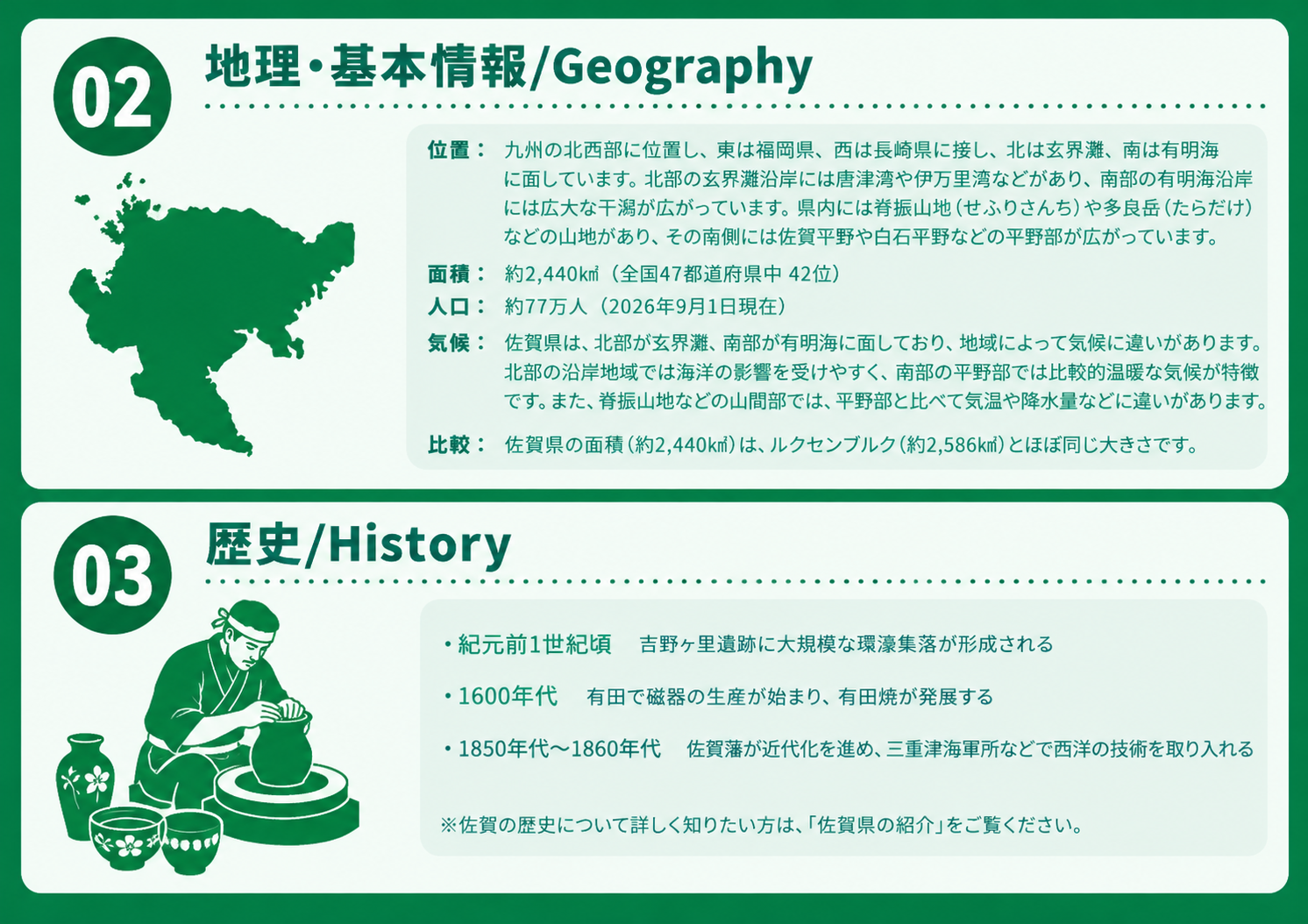
・ Location:Located in the northwestern part of Kyushu, Saga prefecture borders Fukuoka Prefecture to the east and Nagasaki Prefecture to the west. It faces the Genkai Sea to the north and the Ariake Sea to the south. The northern coast facing the Genkai Sea includes Karatsu Bay and Imari Bay, while the southern coast along the Ariake Sea is home to extensive tidal flats. The prefecture has mountainous areas, including the Sefuri Mountains and Mount Tara, with plains such as the Saga Plain and the Shiroishi Plain stretching out to the south.
・ Area:Approximately 2,440 km² (Ranked 42nd among Japan’s 47 prefectures)
・ Population:Approximately 770,000 (as of September 1, 2026)
・ Climate:Saga Prefecture faces the Genkai Sea to the north and the Ariake Sea to the south, resulting in regional variations in climate. The northern coastal areas are more strongly influenced by the sea, while the southern plains are characterized by a relatively mild climate. In mountainous areas such as the Sefuri Mountains, temperatures and precipitation levels differ from those in the plains.
・Size Comparison:Saga Prefecture, with an area of approximately 2,440 km², is roughly the same size asGrand Duchy of Luxembourg , which covers approximately 2,586 km².
03:歴史/History
・Around the 1st century BCE:A large-scale moated settlement developed at the Yoshinogari Site.
・1600s: Porcelain production began in Arita, leading to the development of Arita ware.
・1850s–1860s: The Saga Domain pursued modernization and adopted Western technologies at facilities such as the Miezu Naval Dock.
*For more information about Saga’s history, please see “Introduction to Saga.”
04:文化・伝統/Culture and traditions
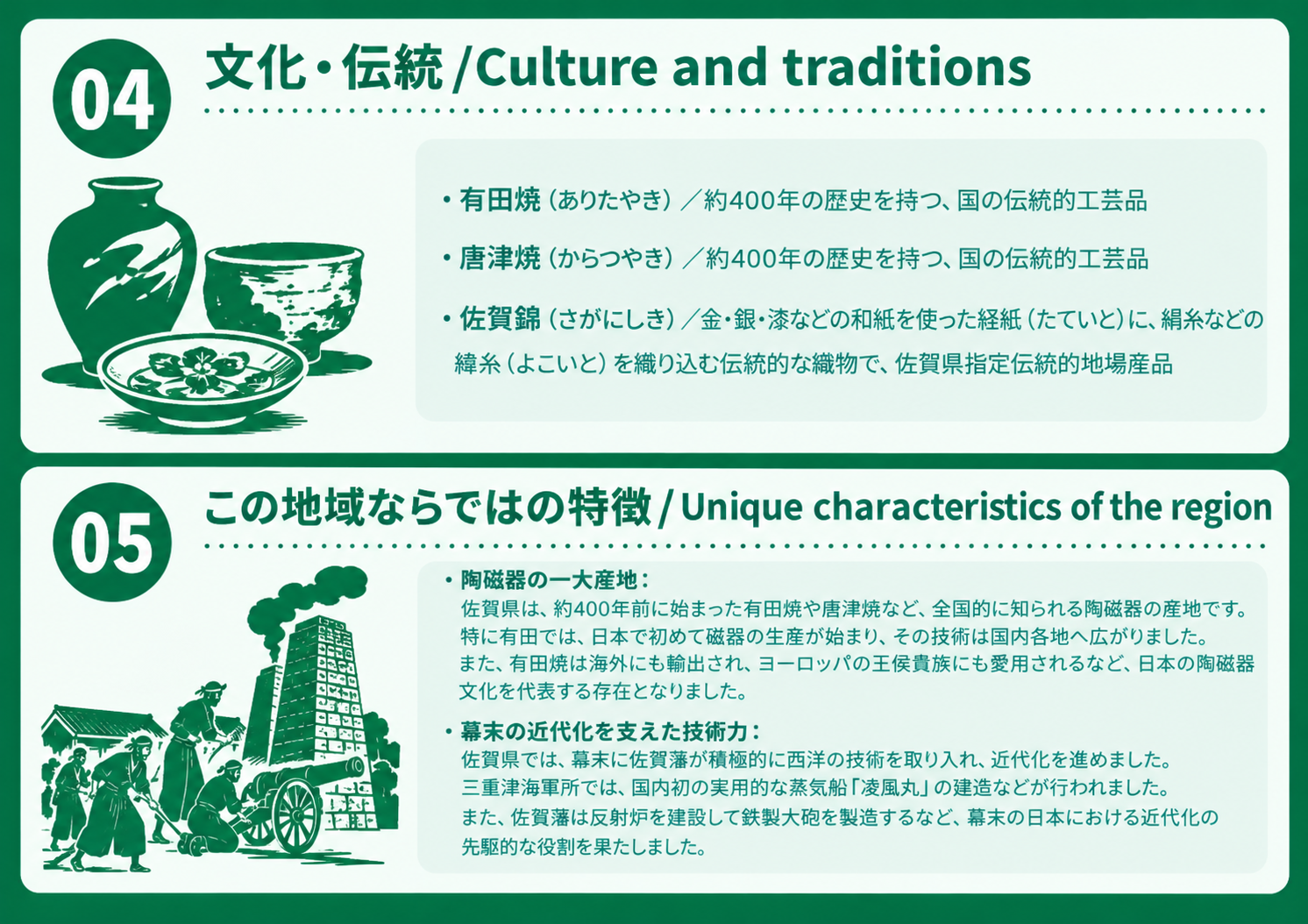
・有田焼 / Arita Ware :A national designated traditional craft with a history of approximately 400 years
・唐津焼 / Karatsu Ware :A national designated traditional craft with a history of approximately 400 years
・佐賀錦 / Saga Nishiki :A traditional textile woven by interlacing silk threads and other fibers as weft with a warp made from strips of Japanese paper decorated with gold and silver leaf or lacquer. It is designated as a traditional local product by Saga Prefecture
05:この地域ならではの特徴/Unique characteristics of the region
・A Major Center for Ceramics:
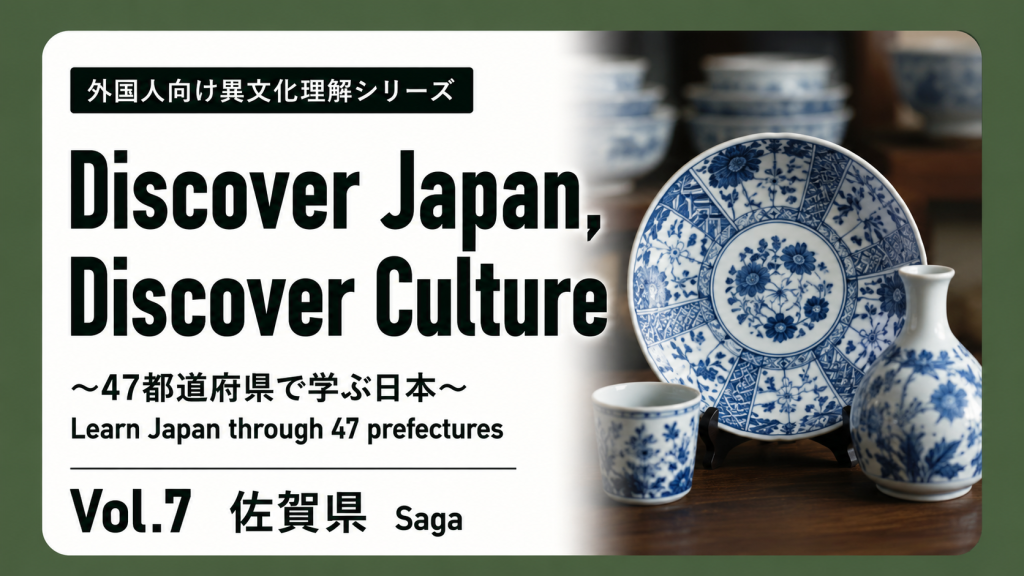
Saga Prefecture is a nationally renowned center for ceramics, including Arita ware and Karatsu ware, both of which date approximately 400 years. In Arita, Japan’s first porcelain was produced, and the techniques subsequently spread throughout the country. Arita ware was also exported overseas and became a representative symbol of Japanese ceramic culture, prized by European royalty and nobility.
・Technological Capabilities That Supported Modernization in the Late Edo Period:
During the late Edo period, the Saga Domain actively adopted Western technologies and promoted modernization. At the Miezu Naval Dock, activities included the construction of the “Ryofu-maru,” Japan’s first practical steam-powered ship. The Saga Domain also played a pioneering role in Japan’s modernization during this period by building reverberatory furnace to produce iron cannons.
06:世界とのつながり・異文化比較/Global connections and cross-cultural comparisons
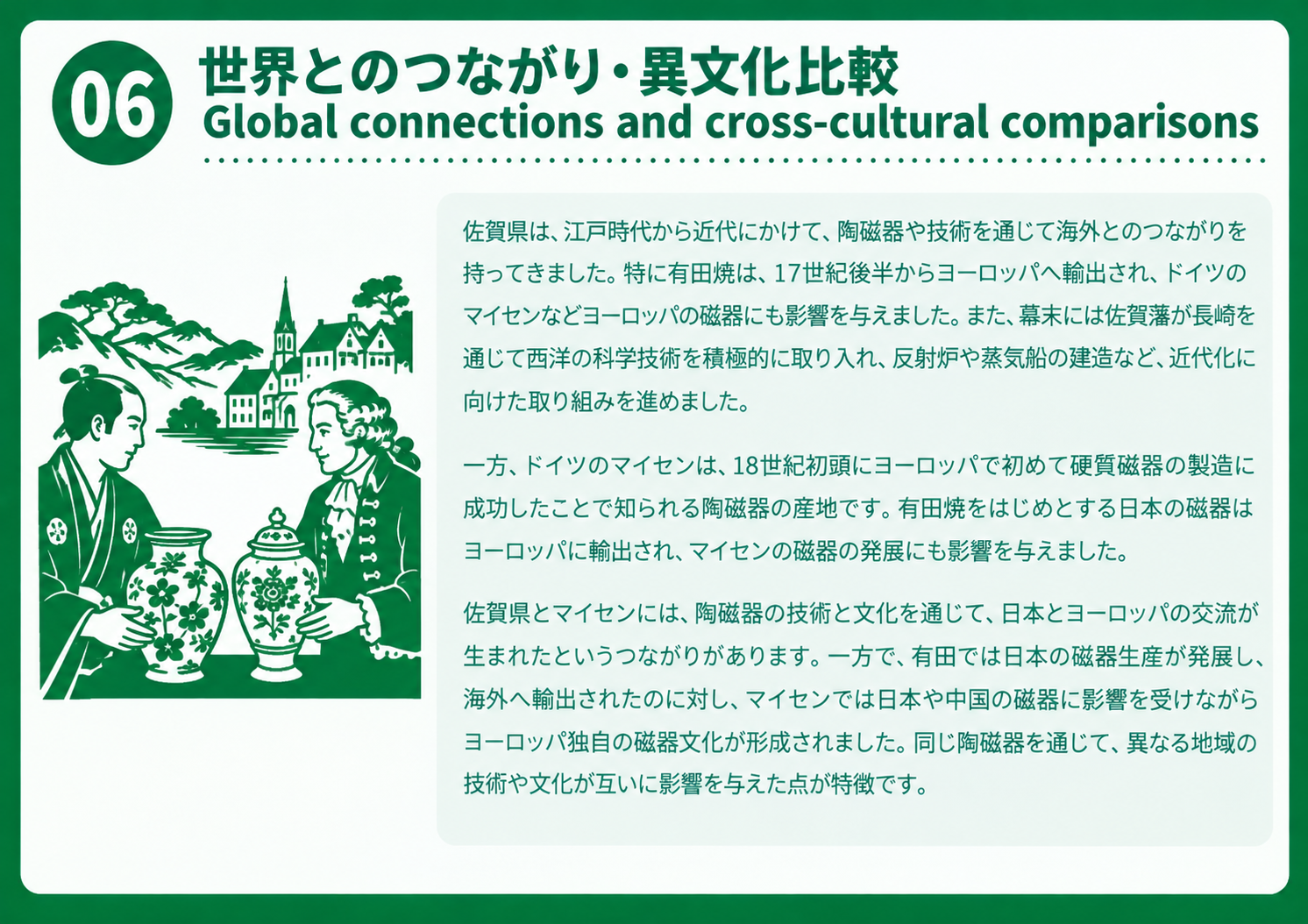
From the Edo period through the modern era, Saga Prefecture has maintained connections with other countries through ceramics and technology. In particular, Arita ware was exported to Europe from the late 17th century onward and influenced European porcelain, including that produced in Meissen, Germany. During the late Edo period, the Saga Domain also actively adopted Western science and technology through Nagasaki, pursuing modernization through initiatives such as the construction of reverberatory furnaces and steamships.
Meissen, Germany, is known as the place where hard-paste porcelain was first successfully manufactured in Europe in the early 18th century. Japanese porcelain, including Arita ware, was exported to Europe and influenced the development of Meissen porcelain.
Saga Prefecture and Meissen are connected by the fact that exchanges between Japan and Europe that developed through ceramic technology and culture. However, while porcelain production flourished in Arita and its products were exported overseas, Meissen developed a distinctive European porcelain tradition under the influence of Japanese and Chinese porcelain. This relationship illustrates how the technologies and cultures of different regions influenced one another through ceramics.
07:地域のマナー・ルール/Local manners and customs
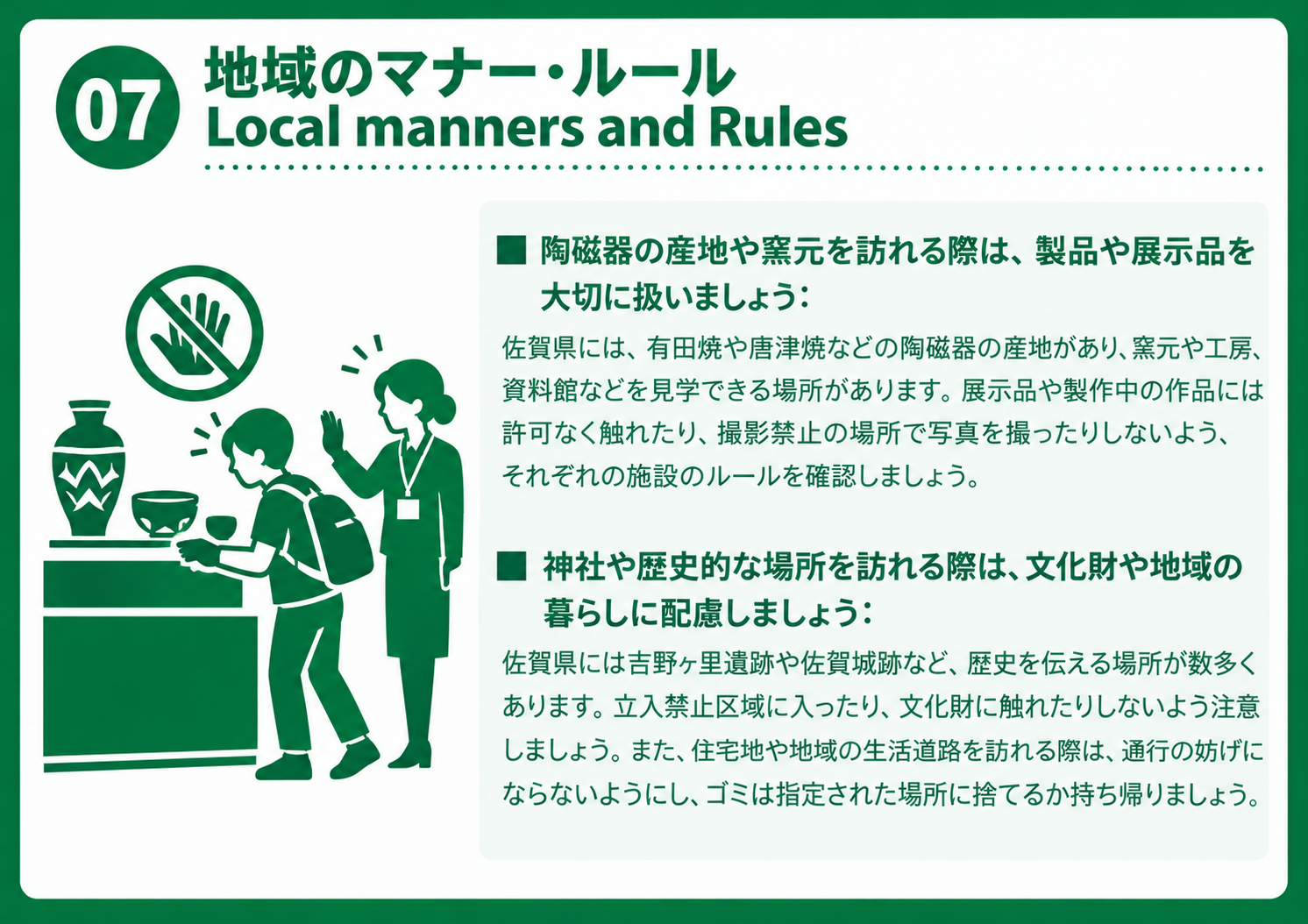
■ When visiting ceramics production areas or pottery studios, please handle products and exhibits with care:
Saga Prefecture is home to ceramics production areas known for Arita ware and Karatsu ware, and some locations offer tours of pottery studios, workshops, and museums. Please follow the rules at each facility. Do not touch exhibits or works in progress without permission, and refrain from taking photos in areas where photography is prohibited.
■ When visiting shrines and historical sites, please respect cultural properties and the local residents’ way of life:
Saga Prefecture is home to many places that preserve its history, including the Yoshinogari Site and the ruins of Saga Castle. Please do not enter restricted areas or touch cultural properties. When visiting residential neighborhoods or using local roads, please avoid obstructing traffic. Dispose of trash in designated areas or take it home with you.
08:祭・伝統行事/Festivals and traditional events
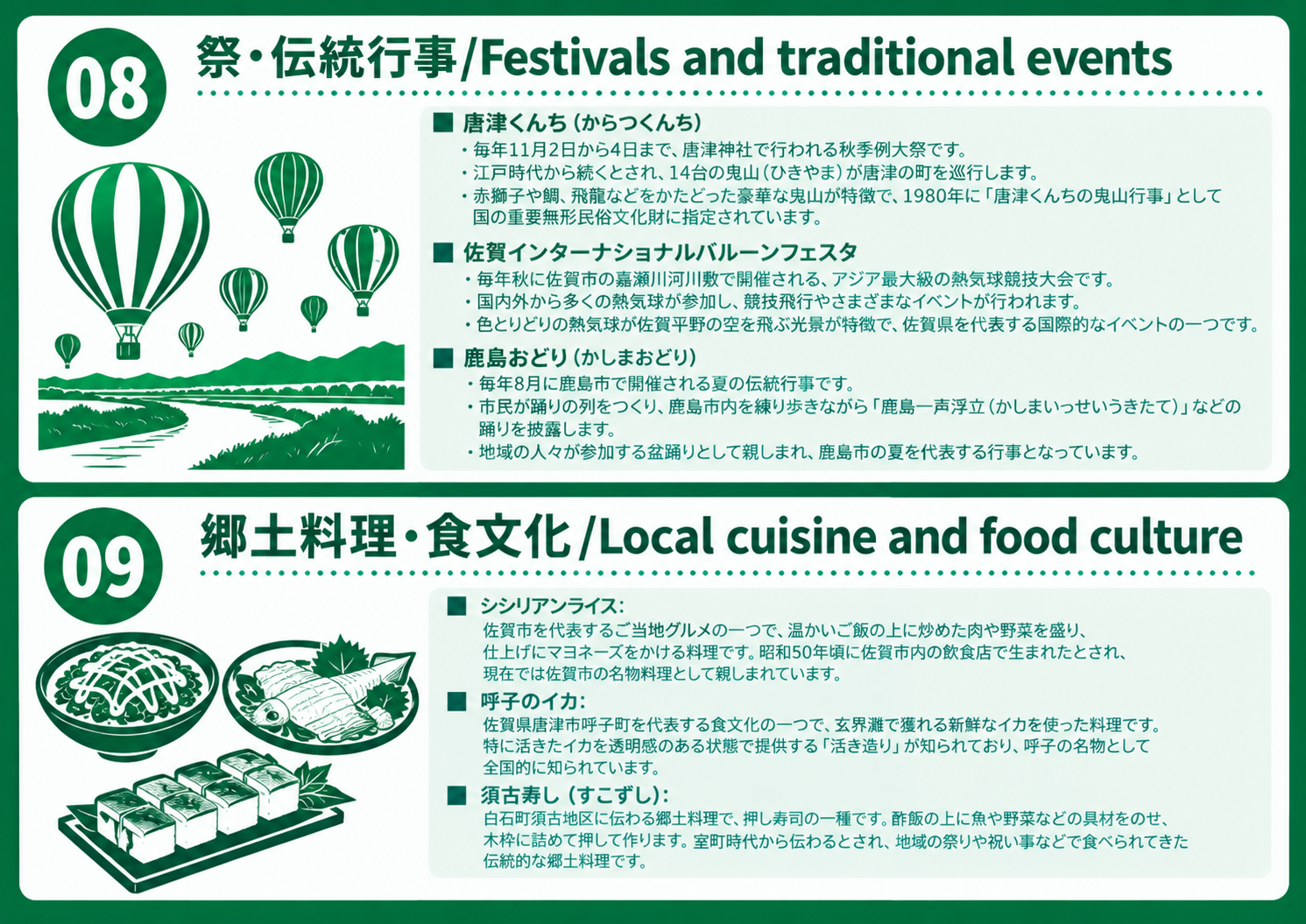
■ 唐津くんち / Karatsu Kunchi
・An annual autumn festival held at Karatsu Shrine from November 2 to 4 each year.
・Believed to have originated in the Edo period, the festival features 14 ornate floats known as hikiyama, which parade through the streets of Karatsu.
・The festival is known for its lavish floats shaped like red lions, sea bream, and flying dragons. In 1980, the “Karatsu Kunchi Float Procession” was designated as a National Important Intangible Folk Cultural Property.
■ 佐賀インターナショナルバルーンフェスタ / Saga International Balloon Fiesta
・A international renowned hot-air ballon competition held every autumn on the riverbed of the Kase River in Saga City. It is one of the largest hot-air balloon competitions in Asia.
・Hot-air balloons from Japan and overseas take part in competitive flights and various other events.
・The sight of colorful hot-air balloons flying over the Saga Plain is a defining feature of the event, which is one of Saga Prefecture’s signature international events.
■ 鹿島おどり / Kashima Odori
・A traditional summer event held every August in Kashima City.
・Local residents from lines of dancers and parade through the city while performing dances such as the “Kashima Issei Ukitate.”
・Popular as a bon dance in which local residents participate, it is one of the signature summer events in Kashima City.
09:郷土料理・食文化/Local cuisine and food culture
■ シシリアンライス / Sicilian rice:
One of Saga City’s signature local dishes, Sicilian rice consists of warm rice topped with stir-fried meat and vegetables, finished with mayonnaise. It is said to have originated at a restaurant in Saga City around Showa 50 (around 1975) and is now widely enjoyed as a local specialty.
■ 呼子のイカ / Yobuko Ika:
A local specialty of Yobuko in Karatsu City, Saga Prefecture, this dish features fresh squid caught in the Genkai Sea. It is particularly known for “ikizukuri,” a preparation in which freshly caught squid is served as sashimi while is still translucent. Yobuko Ika is widely recognized throughout Japan as a regional specialty.
■ 須古寿し(すこずし)/ Suko-zushi :
A traditional local dish passed down in the Suko district of Shiroishi Town, Suko-zushi is a type of pressed sushi. Fish, vegetables, and other ingredients are placed on vinegared rice, which is packed into a wooden mold and pressed. Believed to date back to the Muromachi period (1336-1573), this traditional dish has long been enjoyed at local festivals and celebrations.
10:公式情報・外国人向け情報/Official information and resources for international residents
■佐賀県公式ホームページ / Saga Prefecture Official Website
■公益財団法人 佐賀県国際交流協会 / Saga International Relations Association (SPIRA)
■さが多文化共生センター / Center for Multicultural Society in Saga
This article has been prepared by our staff based on official information provided by the Saga Prefectural Government, the Agency for Cultural Affairs, the Japan Tourism Agency, and other official sources. The information in this article is based on information available at time of publication. For the latest information, please refer to the relevant official websites.
クロスザボーダー編集部
日本在住の全ての外国人のために様々な有益な情報をまとめたサイトをオープンしました。アルバイトや就職情報はもちろんのこと、日本での生活の安定・安心・安全に繋がる基盤情報や、より日本での生活を充実してもらうようための様々な情報を提供しております。一つでも多くの有益な情報を提供することで、皆さんの選択肢が増え、より豊かな日本での生活を送ってもらうことをサポートいたします。
https://www.crosstheborder.biz/