01:長崎県とは?/Introduction
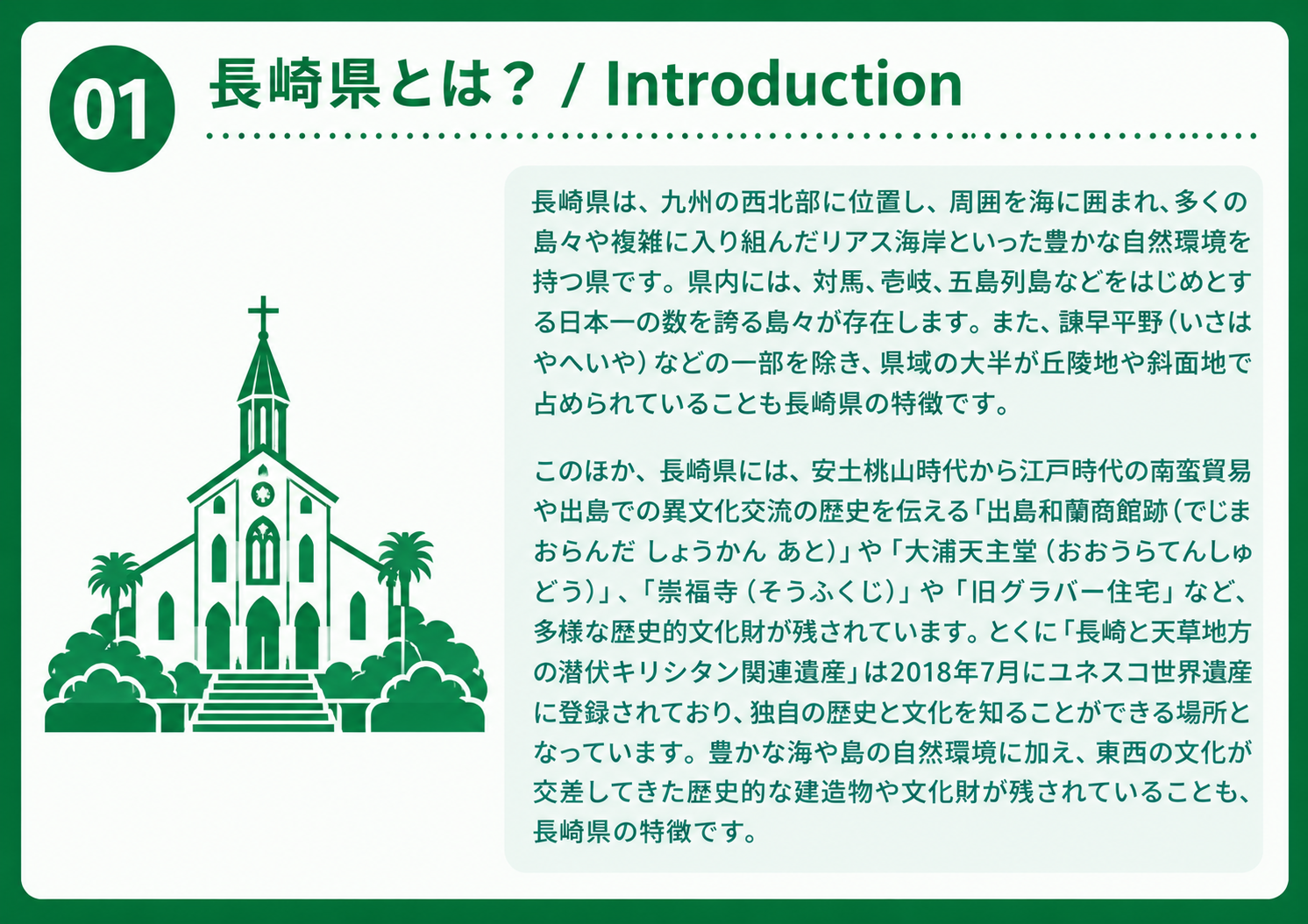
Nagasaki Prefecture is located in the northwestern part of Kyushu. Surrounded by the sea, it boasts a rich natural environment, including numerous islands and a complex, indented rias coastline. The prefecture boasts the largest number of islands in Japan, including Tsushima, Iki, and the Goto Islands. Another characteristic of Nagasaki Prefecture is that, with the exception of areas such as the Isahaya Plain, the majority of its territory consists of hilly and sloping terrain.
In addition, Nagasaki Prefecture is home to a diverse array of historical and cultural assets that convey the history of Nanban trade from the Azuchi-Momoyama period through the Edo period, as well as the cultural exchange that took place on Dejima. These include the “Dejima Dutch Trading Post Ruins,” “Oura Cathedral,” “Sōfuku-ji Temple,” and the “Former Glover Residence.” In particular, the “Hidden Christian Sites in the Nagasaki and Amakusa Regions” were inscribed on the UNESCO World Heritage List in July 2018, making these sites places where visitors can learn about the region’s unique history and culture. In addition to its rich marine and island natural environments, another defining feature of Nagasaki Prefecture is the preservation of historical structures and cultural properties that reflect the intersection of Eastern and Western cultures.
02:地理・基本情報/Geography
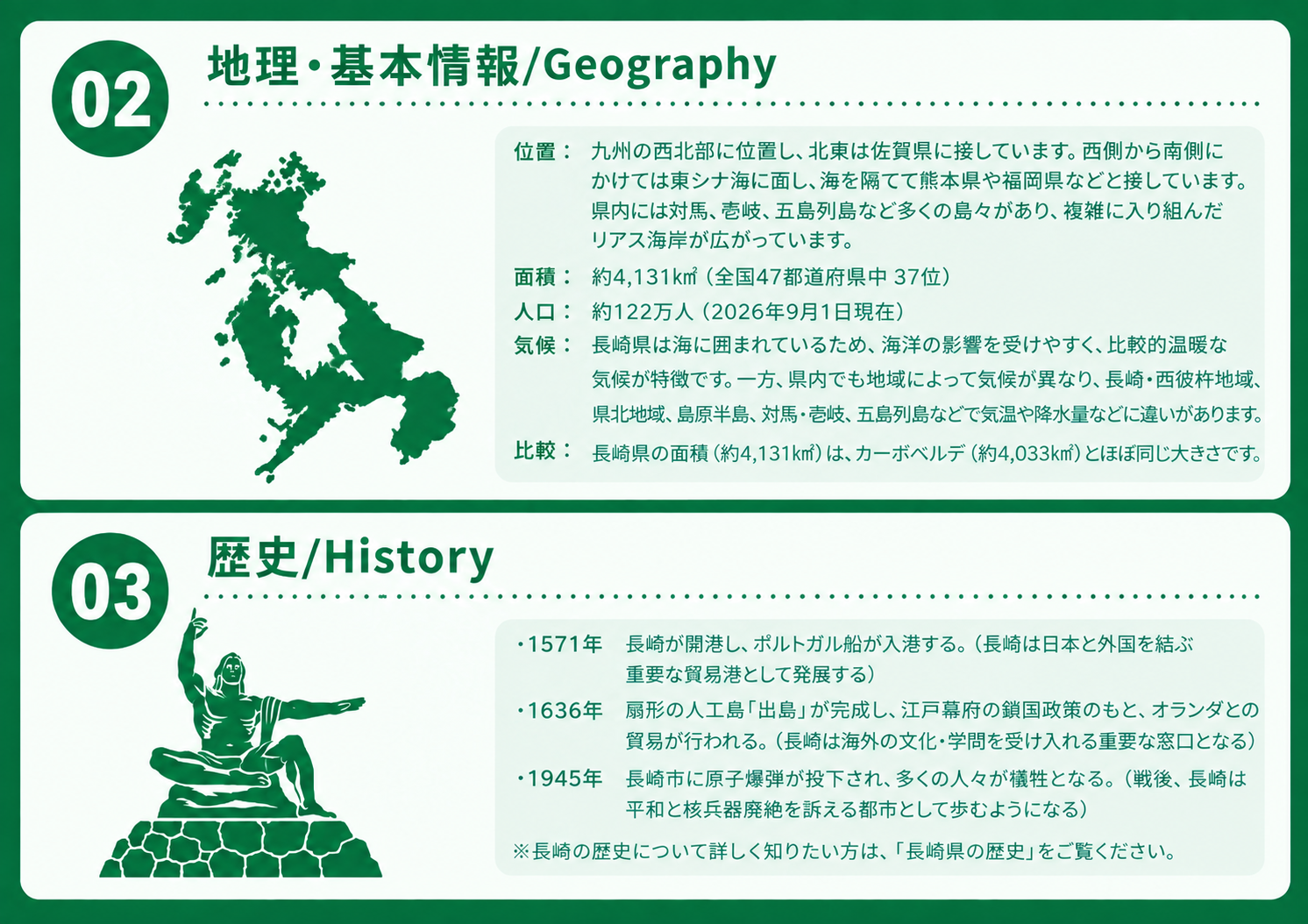
・ Location: Located in the northwestern part of Kyushu, the prefecture borders Saga Prefecture to the northeast. From the west to the south, it faces the East China Sea and is separated from Kumamoto and Fukuoka prefectures by the sea. The prefecture includes many islands, such as Tsushima, Iki, and the Goto Islands, and features a complex, indented rias coastline.
・ Area: Approximately 4,131 km² (Ranked 37th among Japan’s 47 prefectures)
・ Population: Approximately 1.22 million (as of September 1, 2026)
・ Climate: Because Nagasaki Prefecture is surrounded by the sea, it is strongly influenced by the ocean and is characterized by a relatively mild climate. However, the climate varies by region within the prefecture, with differences in temperature and precipitation observed in areas such as the Nagasaki and Nishisonogi regions, the northern part of the prefecture, the Shimabara Peninsula, Tsushima and Iki, and the Goto Islands.
・Size Comparison:The area of Nagasaki Prefecture (approximately 4,131 km²) is roughly the same size as Republic of Cabo Verde (approximately 4,033 km²).
03:歴史/History
・1571:Nagasaki was opened as a port, and Portuguese ships entered the harbor. (Nagasaki developed into an important trade port connecting Japan with the rest of the world.)
・1636:The fan-shaped artificial island “Dejima” was completed, and trade with the Netherlands took place under the Edo shogunate’s policy of national isolation. (Nagasaki became a key gateway for introducing foreign culture and scholarship.)
・1945: An atomic bomb was dropped on Nagasaki, claiming many lives. (After the war, Nagasaki emerged as a city advocating for peace and the abolition of nuclear weapons.)
※If you would like to learn more about the history of Nagasaki, please refer to the following link.
04:文化・伝統/Culture and traditions
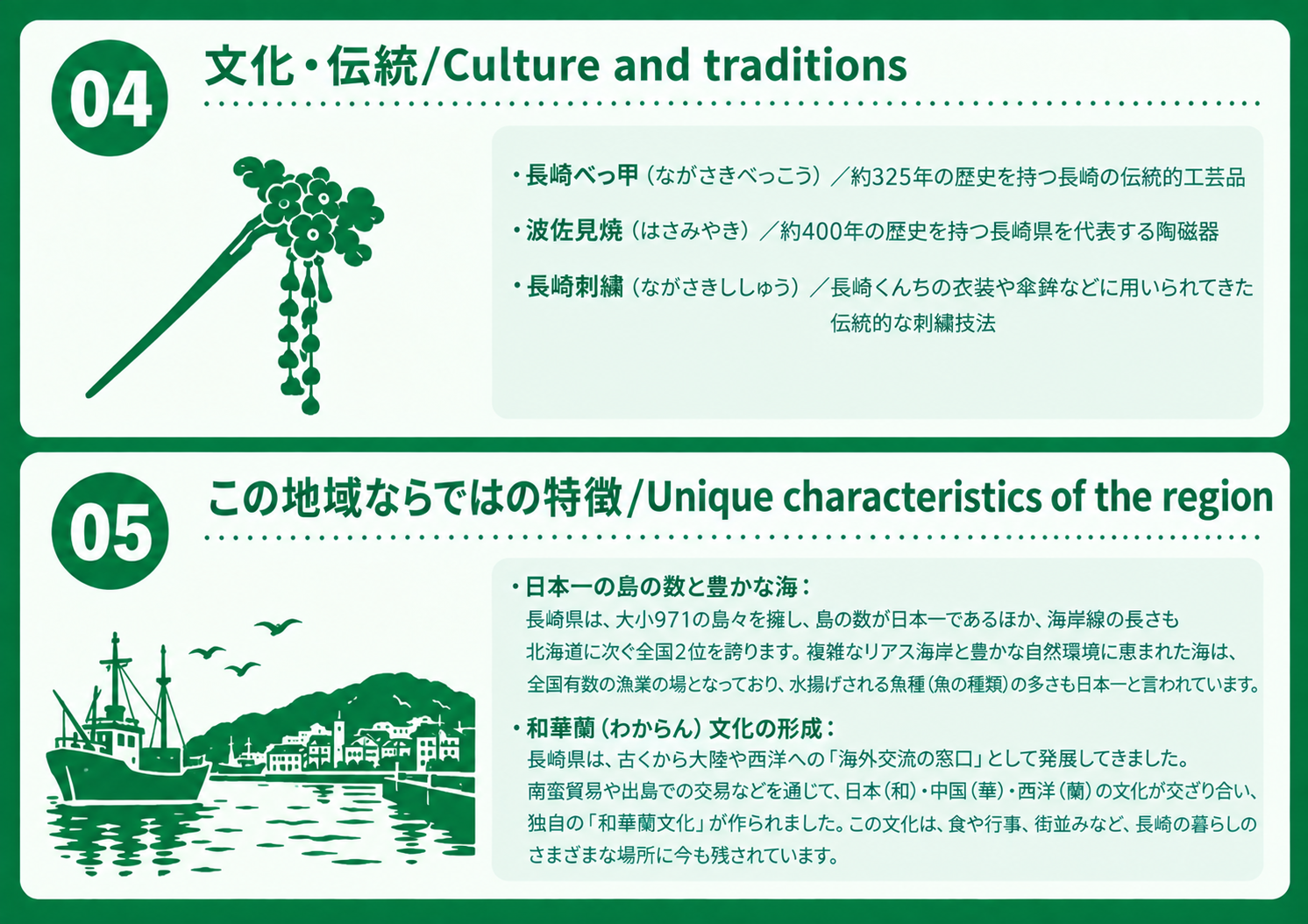
・長崎べっ甲 / Nagasaki Tortoiseshell (Nagasaki Bekko) : A traditional craft from Nagasaki with a history of approximately 325 years
・波佐見焼 / Hasami Ware (Hasami-yaki) : A representative ceramic ware of Nagasaki Prefecture with a history of approximately 400 years
・長崎刺繍 / Nagasaki Embroidery (Nagasaki Shishu) : A traditional embroidery technique used in the costumes and umbrella floats of the Nagasaki Kunchi festival
05:この地域ならではの特徴/Unique characteristics of the region
・The Largest Number of Islands in Japan and a Rich Marine Environment:
Nagasaki Prefecture is home to 971 islands of various sizes, making it the prefecture with the most islands in Japan. It also boasts the second-longest coastline in the country, second only to Hokkaido. Blessed with a complex rias coastline and a rich natural environment, its waters are among the nation’s leading fishing grounds, and the prefecture is said to have the greatest variety of fish species landed in Japan.
・The Formation of “Wakaran” Culture:
Nagasaki Prefecture has long developed as a “gateway for international exchange” with the continent and the West. Through Nanban trade and commerce at Dejima, the cultures of Japan (Wa), China (Hua), and the West (Ran) intermingled, giving rise to a unique “Wakaran” culture. This culture remains evident today in various aspects of daily life in Nagasaki, including cuisine, festivals, and the cityscape.
06:世界とのつながり・異文化比較/Global connections and cross-cultural comparisons
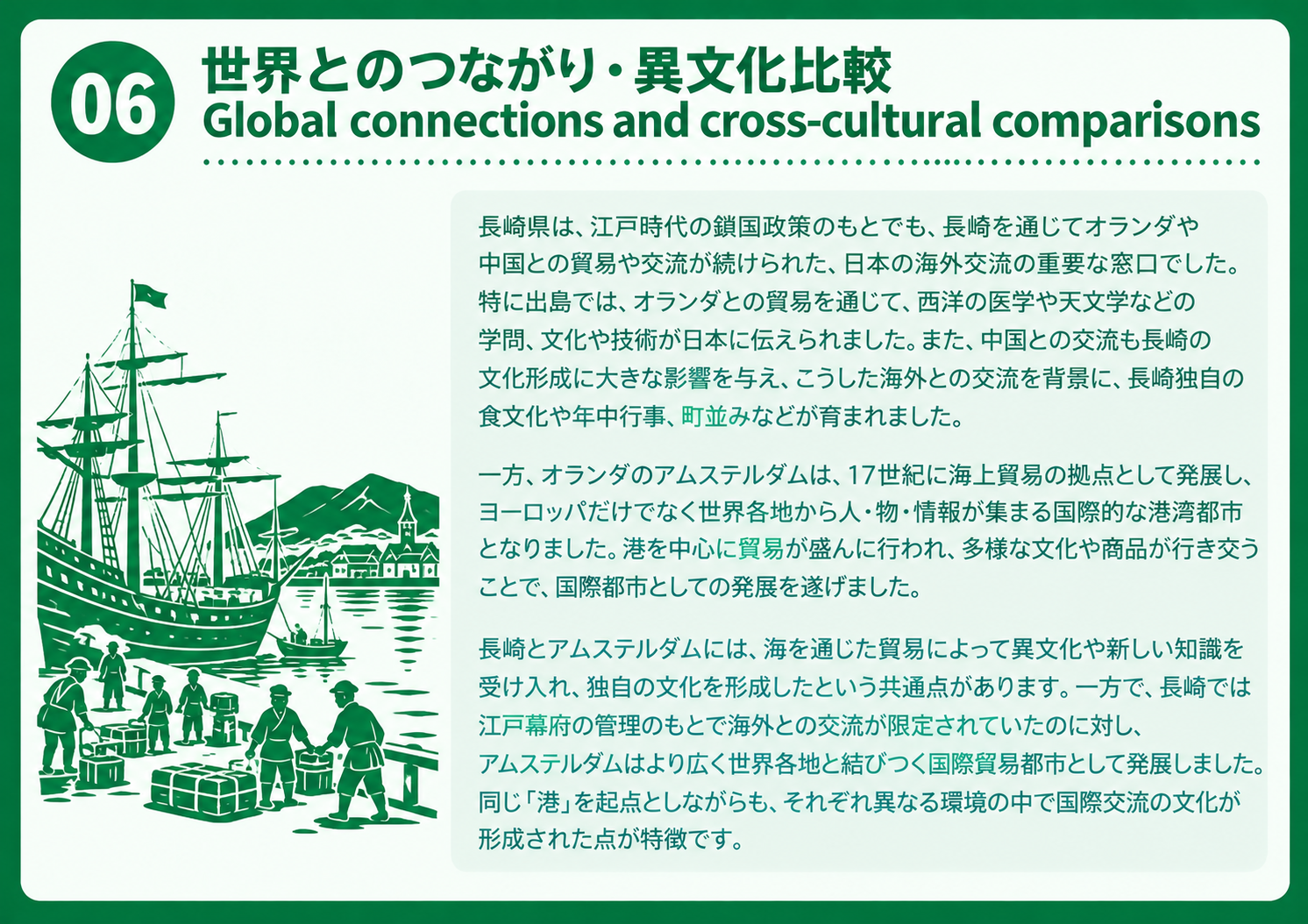
Nagasaki Prefecture served as a vital gateway for Japan’s international exchanges; even under the Edo period’s policy of national isolation, trade and exchanges with the Netherlands and China continued through Nagasaki. In particular, on Dejima, Western scholarship—including medicine and astronomy—as well as culture and technology were introduced to Japan through trade with the Netherlands. Furthermore, exchanges with China also had a significant influence on the formation of Nagasaki’s culture, and against the backdrop of these international interactions, Nagasaki’s unique culinary traditions, annual events, and urban landscape were cultivated.
Meanwhile, Amsterdam, the Netherlands, developed as a hub for maritime trade in the 17th century and became an international port city where people, goods, and information converged not only from Europe but from all over the world. With trade flourishing around its port and a diverse array of cultures and commodities flowing through the city, it flourished as an international metropolis.
Nagasaki and Amsterdam share the common trait of having embraced different cultures and new knowledge through maritime trade, thereby forming their own unique cultures. However, while exchanges with the outside world in Nagasaki were restricted under the control of the Edo Shogunate, Amsterdam developed as an international trading city with broader connections to the rest of the world. A key characteristic is that, although both cities originated as “ports,” their cultures of international exchange took shape within distinct environments.
07:地域のマナー・ルール/Local manners and customs
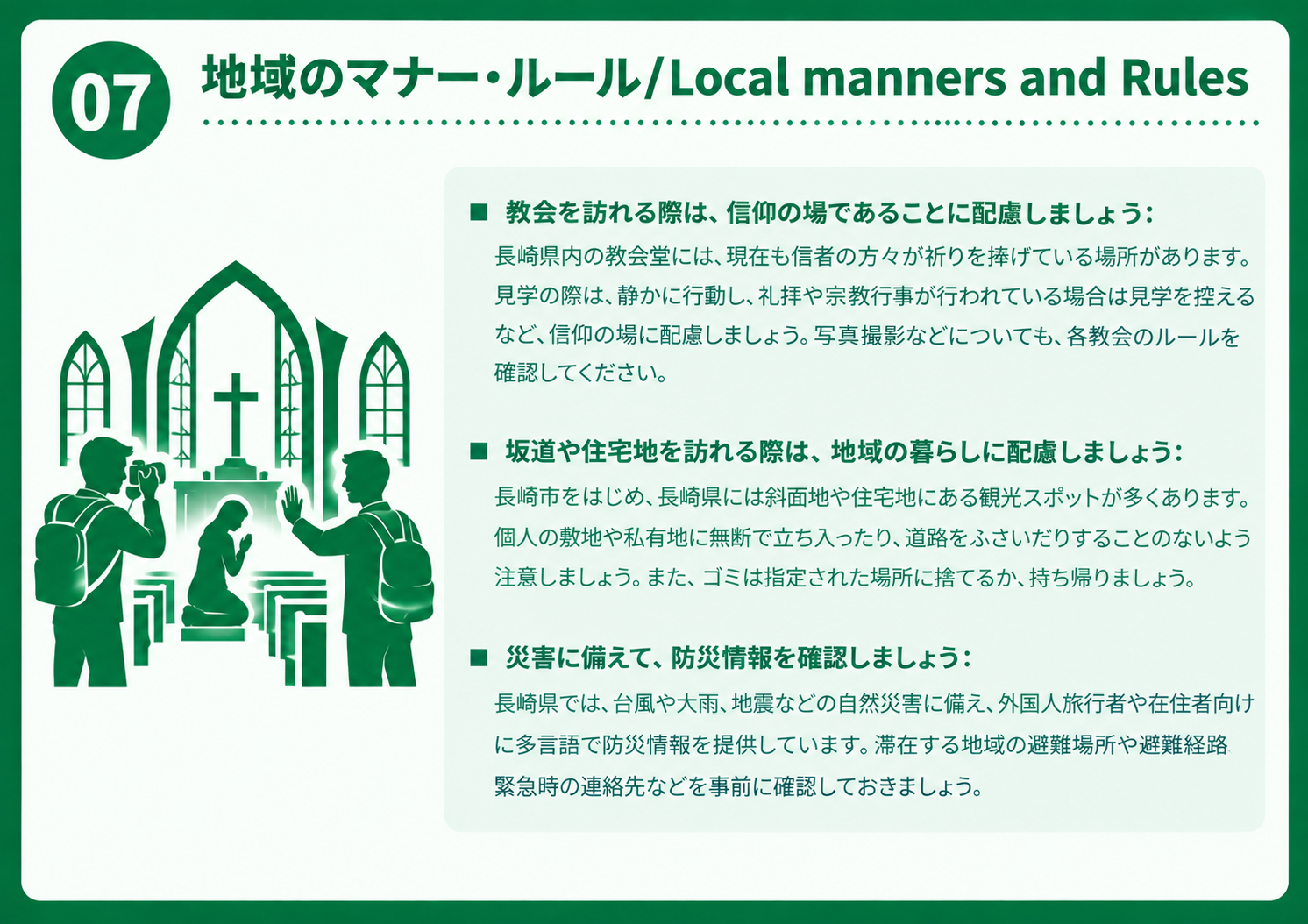
■ When visiting churches, please be mindful that they are places of worship:
Some churches in Nagasaki Prefecture are still used by believers for prayer. When touring these sites, please behave quietly and show respect for the place of worship—for example, by refraining from visiting if a service or religious ceremony is in progress. Please also check each church’s rules regarding photography.
■ When visiting hillsides or residential areas, please be considerate of local residents:
Nagasaki City and the rest of Nagasaki Prefecture feature many tourist spots located on hillsides or in residential areas. Please be careful not to trespass on private property or block roads. Also, please dispose of trash in designated areas or take it with you.
■ Check disaster preparedness information to be prepared for emergencies:
To prepare for natural disasters such as typhoons, heavy rain, and earthquakes, Nagasaki Prefecture provides multilingual disaster preparedness information for foreign travelers and residents. Be sure to check in advance the evacuation shelters, evacuation routes, and emergency contact information for the area where you are staying.
08:祭・伝統行事/Festivals and traditional events
■ 長崎くんち(ながさきくんち)/ Nagasaki Kunchi
・This is a major autumn festival held annually from October 7 to 9 at Suwa Shrine in Nagasaki City.
・It is said to have begun in the 11th year of the Kan’ei era (1634) and will mark its 392nd anniversary in 2026. The festival is characterized by “dedicatory dances” (performances) that incorporate cultural elements from Portugal, the Netherlands, China, and other countries.
・This festival, where visitors can experience Nagasaki’s unique exotic atmosphere through performances such as the “Dragon Dance (Ja-odori)” and the “Nanban Ship,” has been designated as an Important Intangible Folk Cultural Property of Japan.
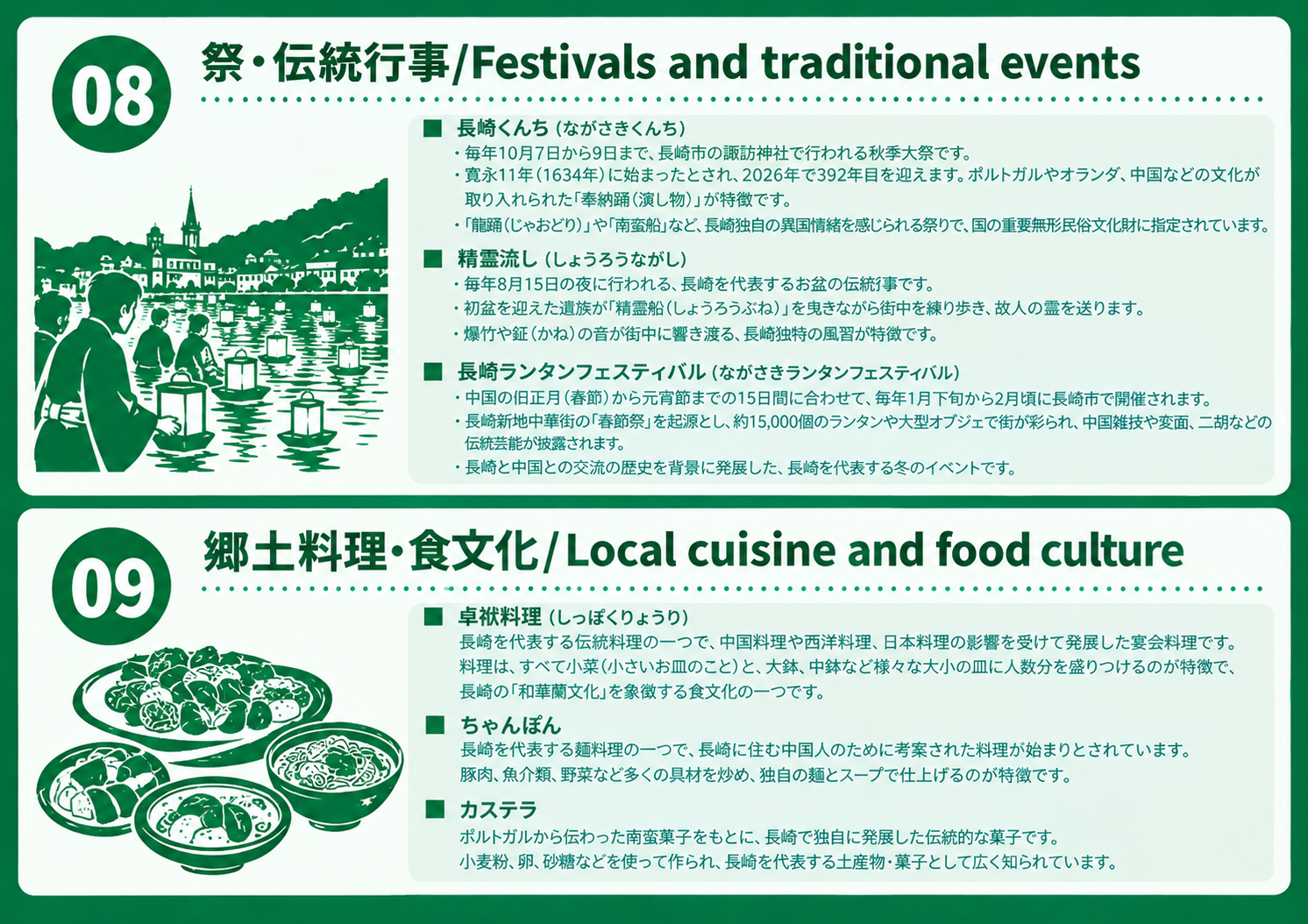
■ 精霊流し(しょうろうながし)/ Shōrō Nagashi (Spirit Boat Procession)
・This is a traditional Obon event representative of Nagasaki, held every year on the night of August 15.
・Families observing their first Obon since a loved one’s passing parade through the city while pulling “Shōrō-bune” (spirit boats) to send off the spirits of the deceased.
・It is characterized by a custom unique to Nagasaki, where the sounds of firecrackers and gongs echo throughout the city.
■ 長崎ランタンフェスティバル / Nagasaki Lantern Festival
・Held annually in Nagasaki City from late January to around February, coinciding with the 15-day period from the Chinese Lunar New Year (Spring Festival) to the Lantern Festival (Yuanxiao Festival).
・Originating from the “Spring Festival” in Nagasaki Shinchi Chinatown, the city is adorned with approximately 15,000 lanterns and large-scale installations, and traditional Chinese performances such as acrobatics, face-changing, and erhu music are showcased.
・Developed against the backdrop of the history of exchange between Nagasaki and China, this is one of Nagasaki’s most representative winter events.
09:郷土料理・食文化/Local cuisine and food culture
■ 卓袱料理(しっぽくりょうり) / Shippoku Cuisine:
One of Nagasaki’s representative traditional cuisines, this banquet-style cuisine developed under the influence of Chinese, Western, and Japanese cuisines. It is characterized by serving all dishes—including small side dishes (served on small plates), as well as large and medium-sized bowls—in a variety of dishes of different sizes, with portions arranged according to the number of guests. It is one of the culinary traditions that symbolizes Nagasaki’s “Wakaran culture.”
■ ちゃんぽん / Champon:
One of Nagasaki’s signature noodle dishes, it is said to have originated as a dish created for the Chinese community living in Nagasaki. It features a variety of ingredients—such as pork, seafood, and vegetables—stir-fried and finished with a unique noodle and broth.
■ カステラ / Castella:
A traditional confectionery that originated from “Nanban” sweets introduced from Portugal and was uniquely developed in Nagasaki. Made with ingredients such as flour, eggs, and sugar, it is widely known as one of Nagasaki’s most representative souvenirs and confections.
10:公式情報・外国人向け情報/Official information and resources for international residents
■長崎県公式ホームページ / Nagasaki Prefecture Official Website
■外国人のみなさまへ / Information for Foreign Residents
■長崎県外国人相談窓口 / Nagasaki Prefecture Consultation Center for Foreign People
■ながさき旅ネット / VISIT NAGASAKI
This article has been prepared by our staff based on official information provided by the Nagasaki Prefectural Government, the Agency for Cultural Affairs, the Japan Tourism Agency, and other official sources. The information in this article is based on information available at time of publication. For the latest information, please refer to the relevant official websites.
クロスザボーダー編集部
日本在住の全ての外国人のために様々な有益な情報をまとめたサイトをオープンしました。アルバイトや就職情報はもちろんのこと、日本での生活の安定・安心・安全に繋がる基盤情報や、より日本での生活を充実してもらうようための様々な情報を提供しております。一つでも多くの有益な情報を提供することで、皆さんの選択肢が増え、より豊かな日本での生活を送ってもらうことをサポートいたします。
https://www.crosstheborder.biz/