01:鹿児島県とは?/Introduction
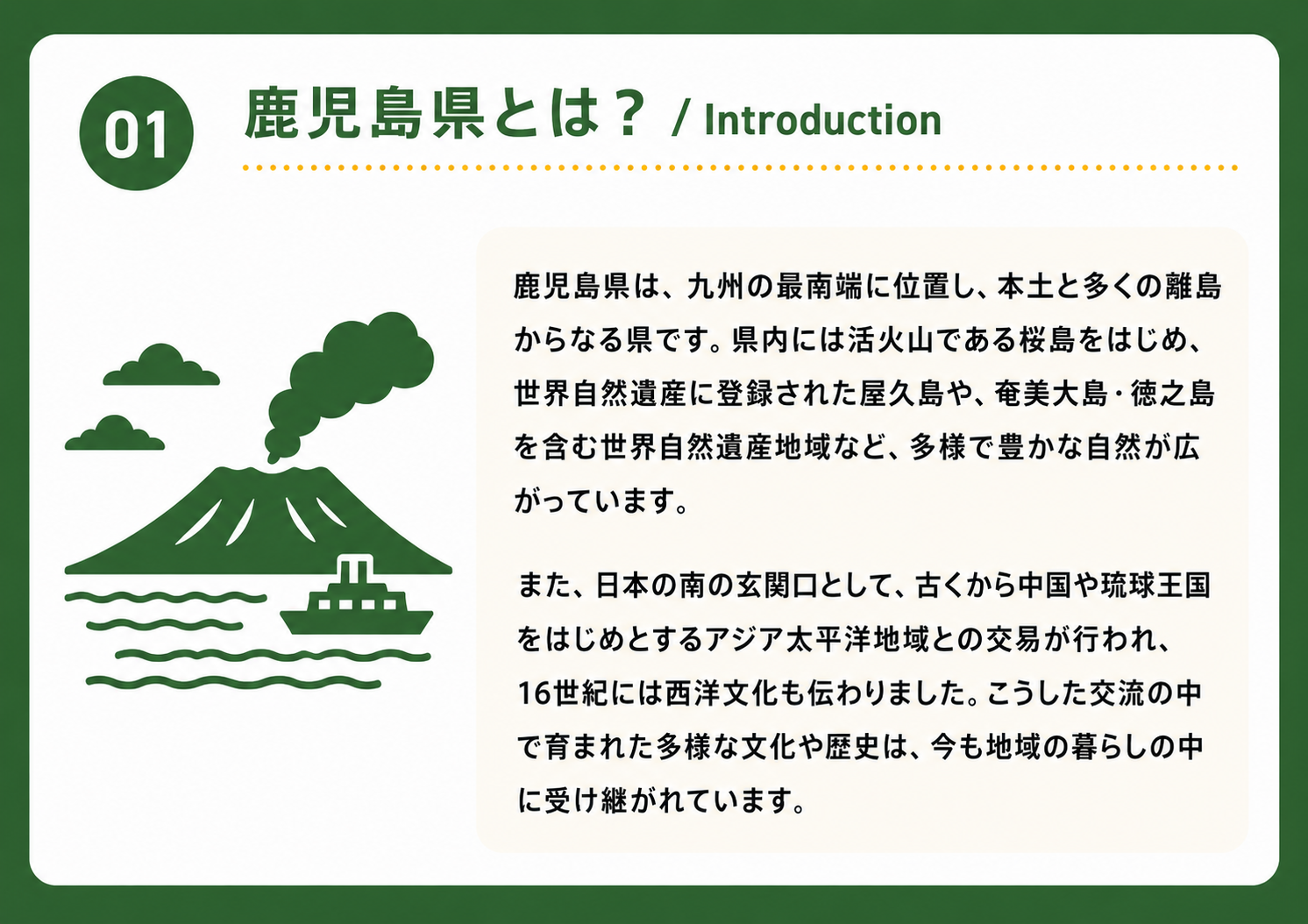
Kagoshima Prefecture is situated at the southernmost tip of Kyushu and comprises the mainland and numerous outlying islands. The prefecture boasts a diverse and rich natural environment, including the active volcano Sakurajima, Yakushima—a UNESCO World Natural Heritage Site—and the World Natural Heritage site that includes Amami-Ōshima and Tokunoshima.
Furthermore, as Japan’s southern gateway, Kagoshima has long been involved in trade with the Asia-Pacific region, including China and the Ryukyu Kingdom, and Western culture was introduced in the 16th century. The diverse culture and history nurtured through these exchanges continue to live on in the everyday lives of local communities.
02:地理・基本情報/Geography
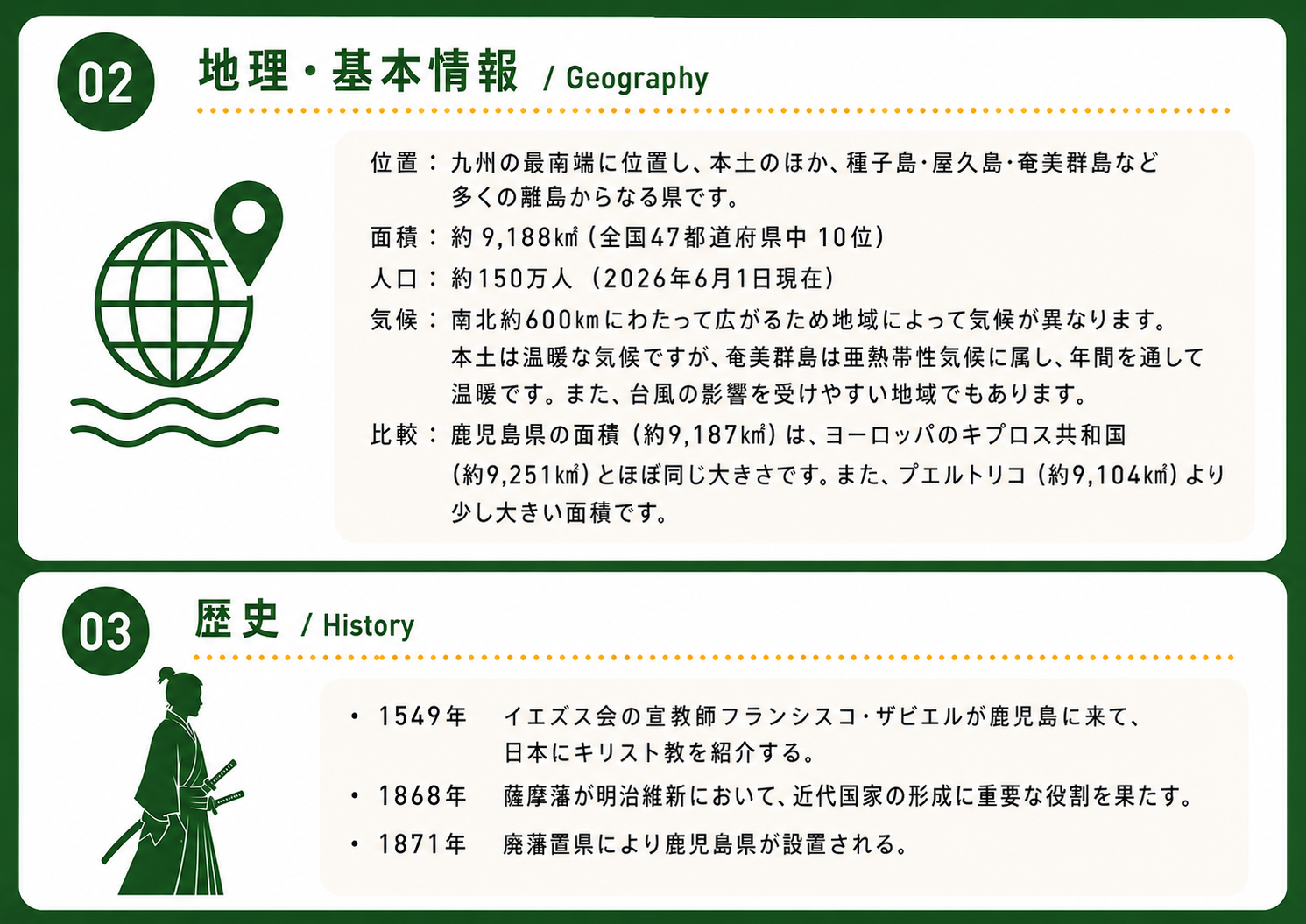
・Location: Situated at the southernmost tip of Kyushu, Kagoshima Prefecture comprises the mainland as well as numerous outlying islands, including Tanegashima, Yakushima and the Amami Islands.
・Area: Approximately 9,188 km² (10th among Japan’s 47 prefectures)
・Population: Approximately 1.5 million (as of 1 June 2026)
・Climate: As the prefecture stretches approximately 600 km from north to south, the climate varies by region. The mainland has a mild climate, whilst the Amami Islands have a subtropical climate and remain warm throughout the year. The prefecture is also frequently affected by typhoons.
・Size Comparison: The area of Kagoshima Prefecture (approximately 9,188 km²) is roughly the same size as the Republic of Cyprus (approximately 9,251 km²). It is also slightly larger than Puerto Rico (approximately 9,104 km²).
03:歴史/History
・1549: The Jesuit missionary Francis Xavier arrived in Kagoshima and introduced Christianity to Japan.
・1868: The Satsuma Domain played a key role in the formation of a modern nation during the Meiji Restoration.
・1871: Kagoshima Prefecture was established as part of the abolition of the feudal domains and the establishment of the prefectural system.
・Satsuma Domain: A feudal domain based mainly in what is now Kagoshima Prefecture.
For more detailed information on the history of Kagoshima, please refer to Kagoshima Prefecture’s official ‘Overview of History’.
04:文化・伝統/Culture and traditions
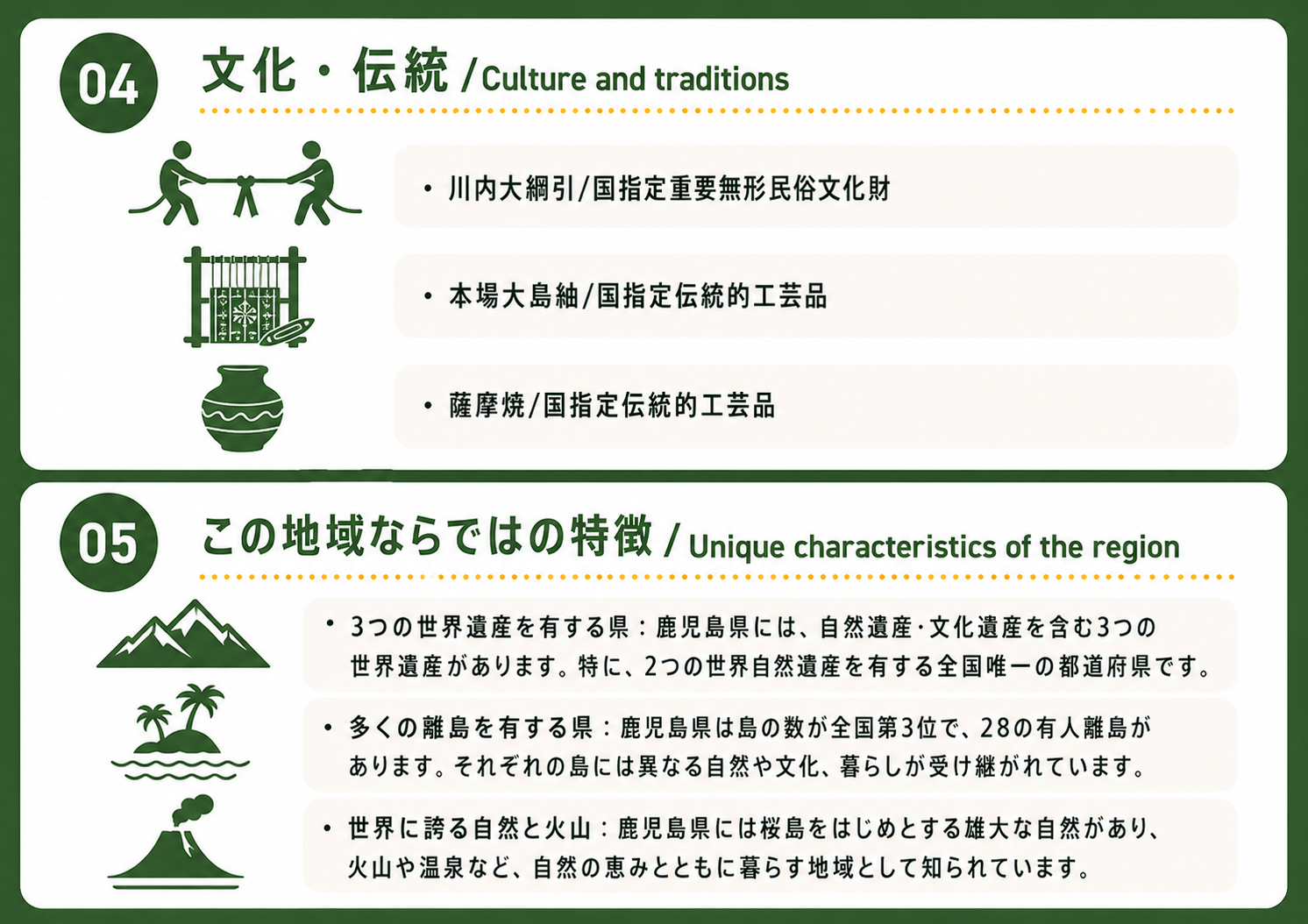
・川内大綱引 / Sendai Great Tug-of-War / Nationally Designated Important Intangible Folk Cultural Property
・本場大島紬 / Honba Oshima Tsumugi (Traditional Oshima Pongee) / Nationally Designated Traditional Craft
・薩摩焼 / Satsuma Ware / Nationally Designated Traditional Craft
05:この地域ならではの特徴/Unique characteristics of the region
・A prefecture with three World Heritage Sites: Kagoshima Prefecture is home to three World Heritage Sites, including both natural and cultural heritage. In particular, it is the only prefecture in Japan to boast two World Natural Heritage Sites.
・A prefecture with numerous outlying islands: Kagoshima Prefecture ranks third in Japan for the number of islands, with 28 inhabited outlying islands. Each island has its own unique natural environment, culture and way of life that have been passed down through the generations.
・World-class natural landscapes and volcanoes: Kagoshima Prefecture boasts magnificent natural landscapes, including Sakurajima, and is known as a region where people live alongside volcanoes and enjoy the benefits of nature, including its hot springs.
06:世界とのつながり・異文化比較/Global connections and cross-cultural comparisons
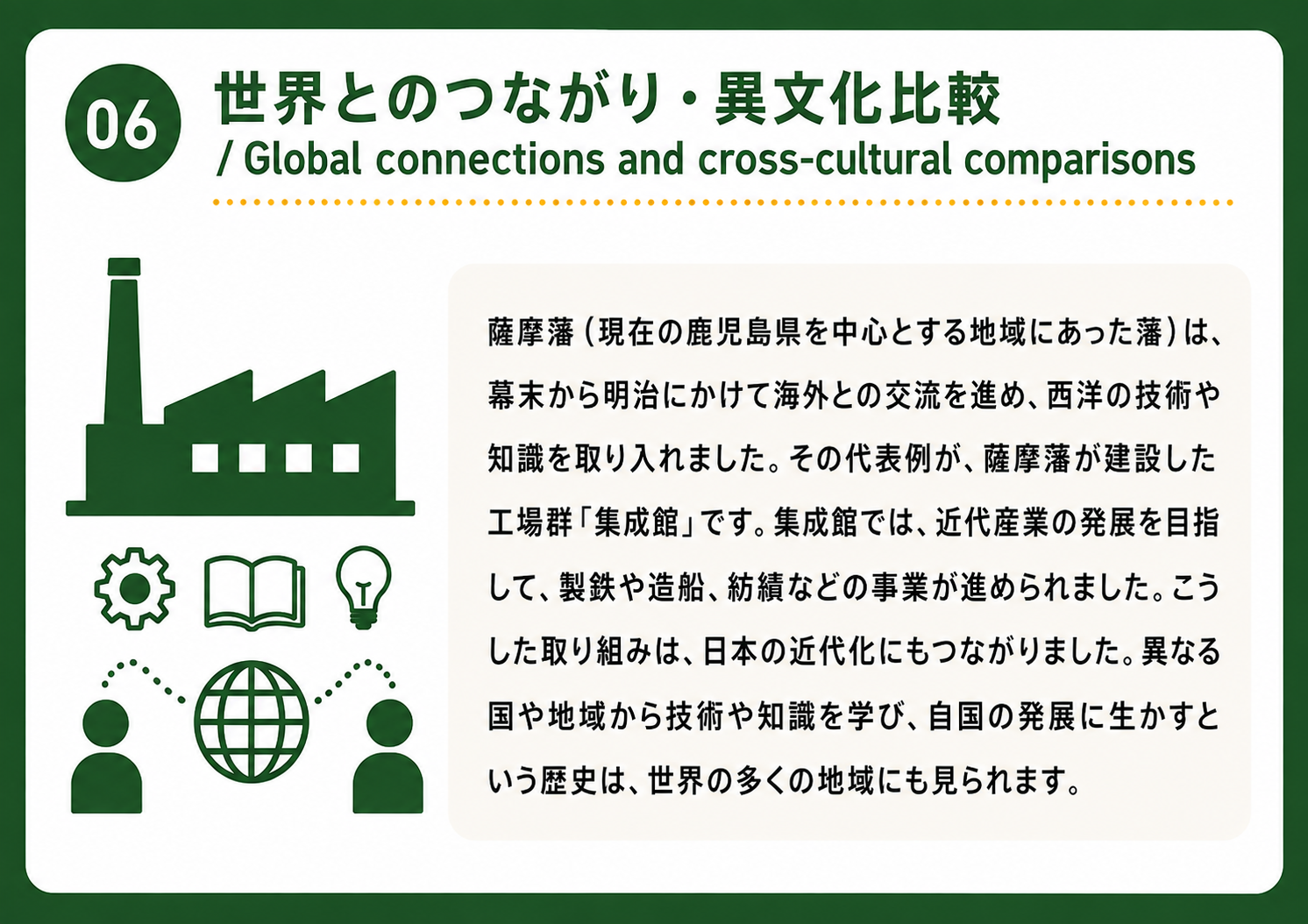
The Satsuma Domain (a feudal domain centered on what is now Kagoshima Prefecture) actively promoted exchanges with countries overseas from the late Edo period through to the Meiji era, adopting Western technology and knowledge. A prime example of this is the ‘Shūseikan’, a complex of factories built by the Satsuma Domain. At the Shūseikan, enterprises such as ironmaking, shipbuilding and textile manufacturing were undertaken with the aim of developing modern industry. These efforts also contributed to Japan’s modernization. The practice of learning technologies and knowledge from different countries and regions and applying them to national development can be seen throughout much of the world.
07:地域のマナー・ルール/Local manners and customs
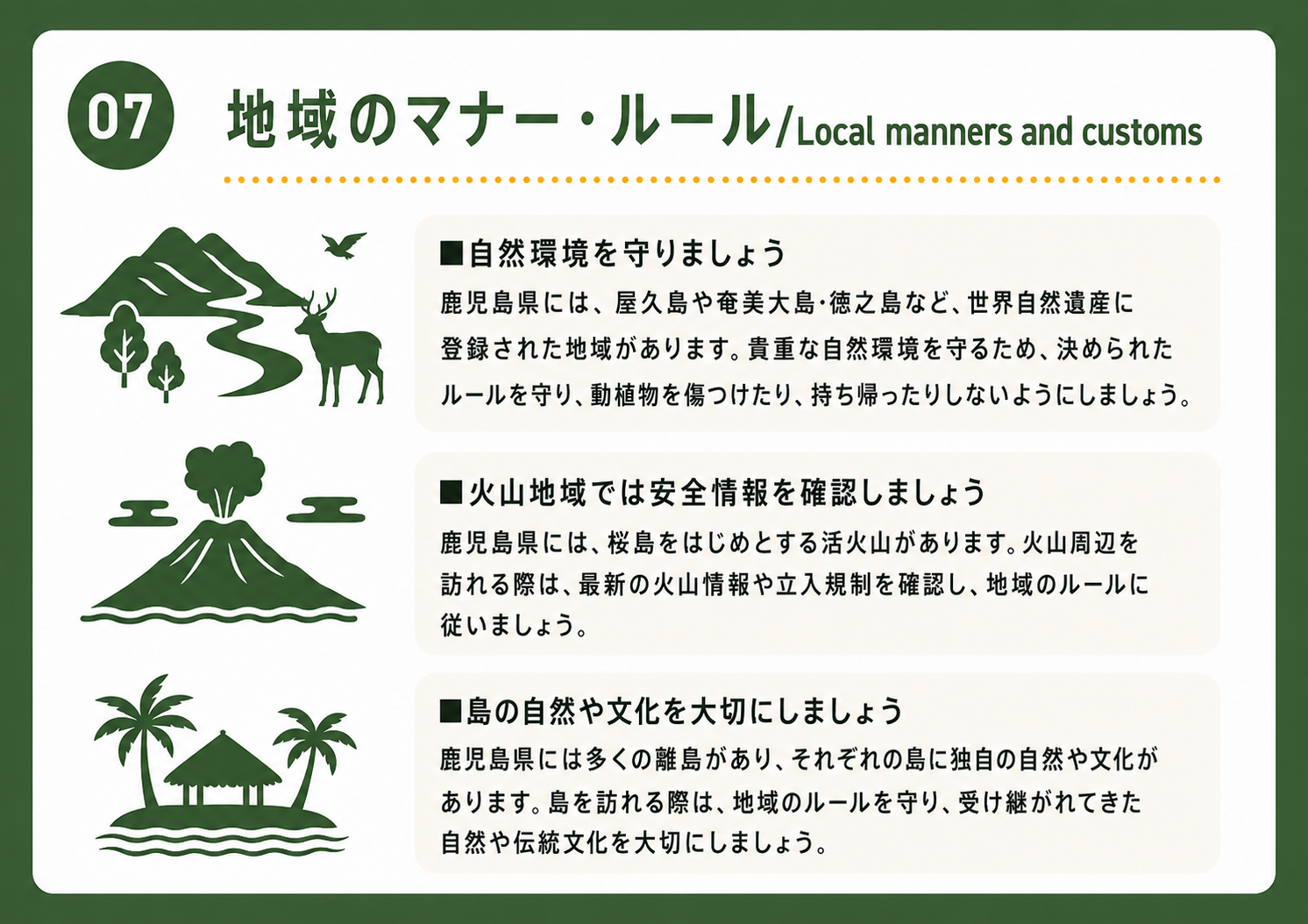
■ Let’s protect the natural environment:
Kagoshima Prefecture is home to areas listed as World Natural Heritage Sites, such as Yakushima, Amami Ōshima and Tokunoshima. To protect these precious natural environments, please observe the rules in place in the areas you visit, and refrain from harming plants and animals or removing them from their natural environment.
■ Check safety information in volcanic areas:
Kagoshima Prefecture is home to active volcanoes, including Sakurajima. When visiting areas around volcanoes, please check the latest volcanic information and access restrictions, and follow local rules.
■ Let’s cherish the natural environment and culture of the islands:
Kagoshima Prefecture has many outlying islands, each with its own unique natural environment and culture. When visiting the islands, please observe local rules and cherish the natural environment and traditional culture that have been passed down through the generations.
08:祭・伝統行事/Festivals and traditional events
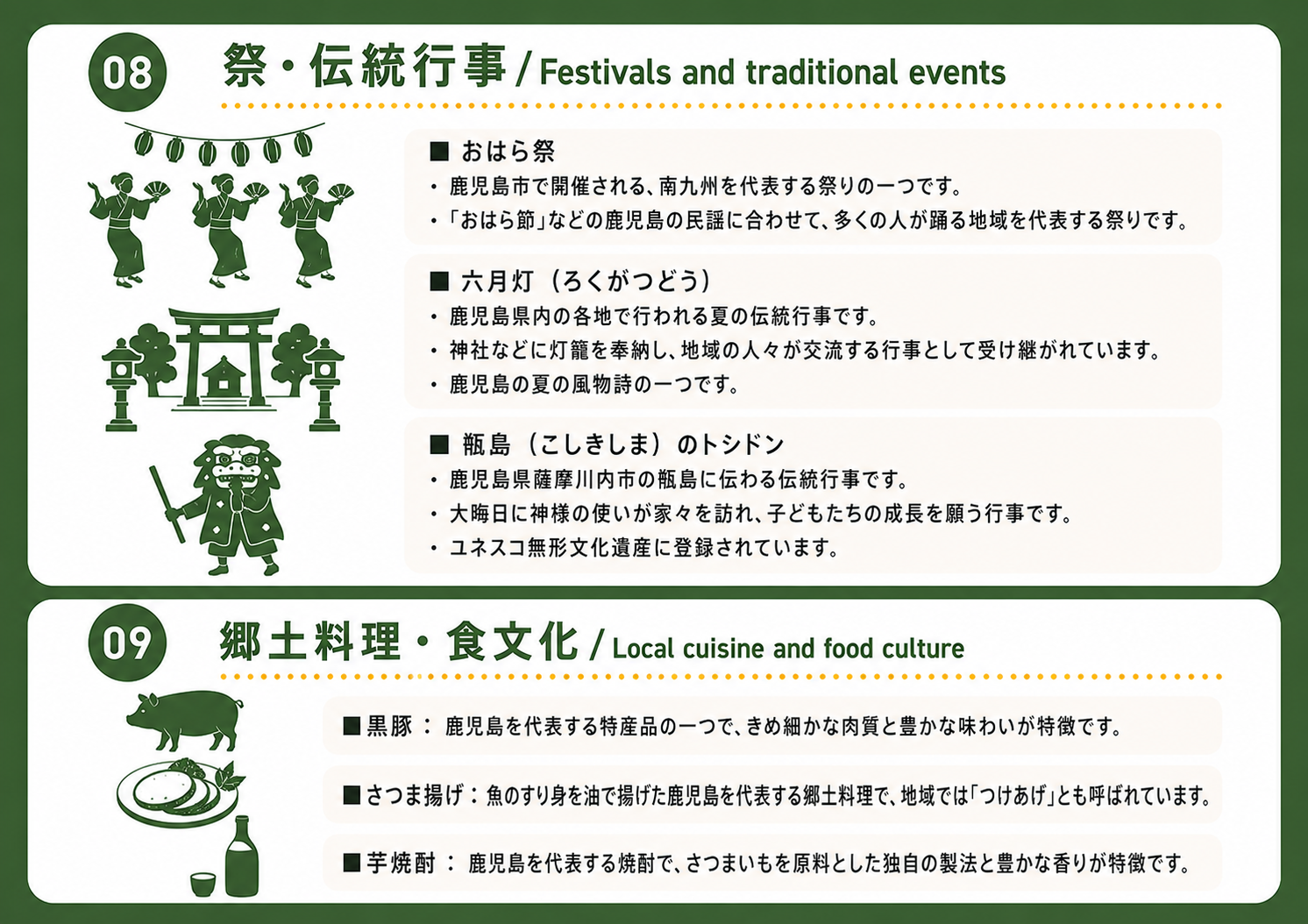
■ おはら祭 / Ohara Festival
・Held in Kagoshima City, this is one of the major festivals of Southern Kyushu.
・Many people dance to Kagoshima folk songs such as Ohara-bushi.
■ 六月灯(ろくがつどう) / Rokugatsu-dō (June Lantern Festival)
・A traditional summer event held in various locations across Kagoshima Prefecture.
・It has been passed down as a tradition in which lanterns are dedicated to shrines, temples and other religious sites.
・It is one of the most iconic features of summer in Kagoshima.
■ 甑島(こしきしま)のトシドン / Toshidon of Koshikijima
・A traditional event passed down on Koshikijima Island in Satsumasendai City, Kagoshima Prefecture.
・On New Year’s Eve, the visiting deity ‘Toshidon’ visits the households with children and offer blessings for their healthy growth.
・It is inscribed on the UNESCO Representative List of the Intangible Cultural Heritage of Humanity as one of the elements of ‘Raiho-shin, ritual visits of deities in masks and costumes’.
09:郷土料理・食文化/Local cuisine and food culture
■ 黒豚 / Kagoshima Black Pork: One of Kagoshima’s signature specialties, known for its fine muscle fibers, tender texture and satisfying bite.
■ さつま揚げ / Satsuma-age: A representative local dish of Kagoshima made from minced fish and deep-fried in oil; it is also known locally as ‘Tsuke-age’.
■ 芋焼酎 / Sweet Potato Shochu: A signature alcoholic beverage of Kagoshima, made from sweet potatoes and characterized by its rich aroma and flavor.
10:公式情報・外国人向け情報/Official information and resources for international residents
■ 鹿児島県公式ホームページ / Kagoshima Prefecture Official Website
■ 鹿児島県外国人総合相談窓口 / Kagoshima Comprehensive Consultation Desk for Foreign Residents
■ 鹿児島県国際交流協会 / Kagoshima International Association
■ 鹿児島県防災Web/かごしま防災ポータル / Kagoshima Disaster Prevention Web / Kagoshima Disaster Prevention Portal
■ 鹿児島県「火山災害への備え」 / Kagoshima Prefecture: ‘Preparing for Volcanic Disasters’
This article has been compiled by our staff based on official information from Kagoshima Prefecture, the Agency for Cultural Affairs, the Japan Tourism Agency and other official sources. The information presented was accurate at the time of writing. Please check the respective official websites for the latest information.
クロスザボーダー編集部
日本在住の全ての外国人のために様々な有益な情報をまとめたサイトをオープンしました。アルバイトや就職情報はもちろんのこと、日本での生活の安定・安心・安全に繋がる基盤情報や、より日本での生活を充実してもらうようための様々な情報を提供しております。一つでも多くの有益な情報を提供することで、皆さんの選択肢が増え、より豊かな日本での生活を送ってもらうことをサポートいたします。
https://www.crosstheborder.biz/