01:大分県とは?/Introduction
Oita Prefecture is located in the northeastern part of Kyushu and is blessed with abundant natural beauty, facing the Seto Inland Sea. The prefecture is home to many hot spring resorts, including Beppu and Yufuin, and its hot springs are one of Oita Prefecture’s most representative regional resources. In addition, the prefecture is home to a diverse natural environment encompassing mountains, peninsulas, and the sea, including the Kuju Mountain Range, the Kunisaki Peninsula, and the Bungo Channel.
Oita Prefecture is also home to a wealth of culture and traditions that have been passed down through its long history, including Usa Jingu Shrine, the Rokugo-Manzan culture that remains on the Kunisaki Peninsula, and the Hita Gion Festival. In addition to its abundant natural beauty and hot spring resources, another major characteristic of Oita Prefecture is the unique history and culture that continue to thrive in each region.
02:地理・基本情報/Geography
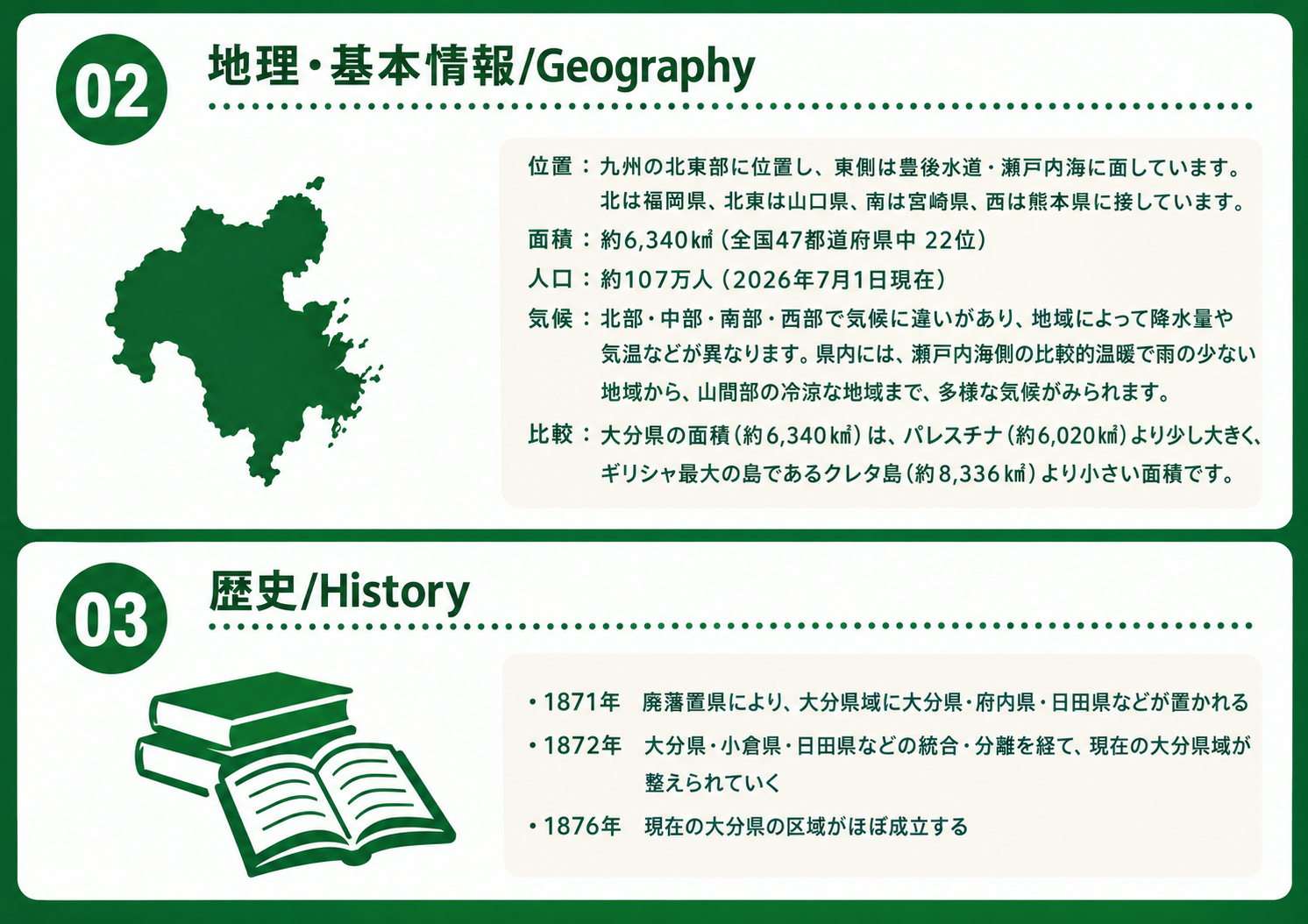
・ Location: Located in the northeastern part of Kyushu, Oita prefecture faces the Bungo Channel and the Seto Inland Sea to the east. It borders Fukuoka Prefecture to the north, Yamaguchi Prefecture to the northeast, Miyazaki Prefecture to the south, and Kumamoto Prefecture to the west.
・ Area: Approximately 6,340 km² (Ranked 22nd among Japan’s 47 prefectures)
・ Population: Approximately 1.07 million (as of July 1, 2026)
・ Climate: The climate varies across the northern, central, southern, and western regions, with differences in precipitation and temperature depending on the area. The prefecture features a diverse range of climates, from the relatively warm areas with low rainfall along the Seto Inland Sea to the cool mountainous regions.
・Size Comparison: Oita Prefecture’s area (approximately 6,340 km²) is slightly larger than Palestine (approximately 6,020 km²) and smaller than Crete, the largest island in Greece (approximately 8,336 km²).
03:歴史/History
・1871: Following the abolition of the han system and the establishment of prefectures, Oita Prefecture, Funai Prefecture, Hita Prefecture, and others were established in what is now Oita Prefecture.
・1872:Through a series of mergers and separations involving Oita Prefecture, Kokura Prefecture, Hita Prefecture, and others, the area that is now Oita Prefecture gradually began to take shape.
・1876:The boundaries of present-day Oita Prefecture were largely established.*For more information on the history of Oita, please visit the “Oita City Digital Archive.”
*For more information on the history of Oita, please visit the “Oita City Digital Archive.”
04:文化・伝統/Culture and traditions
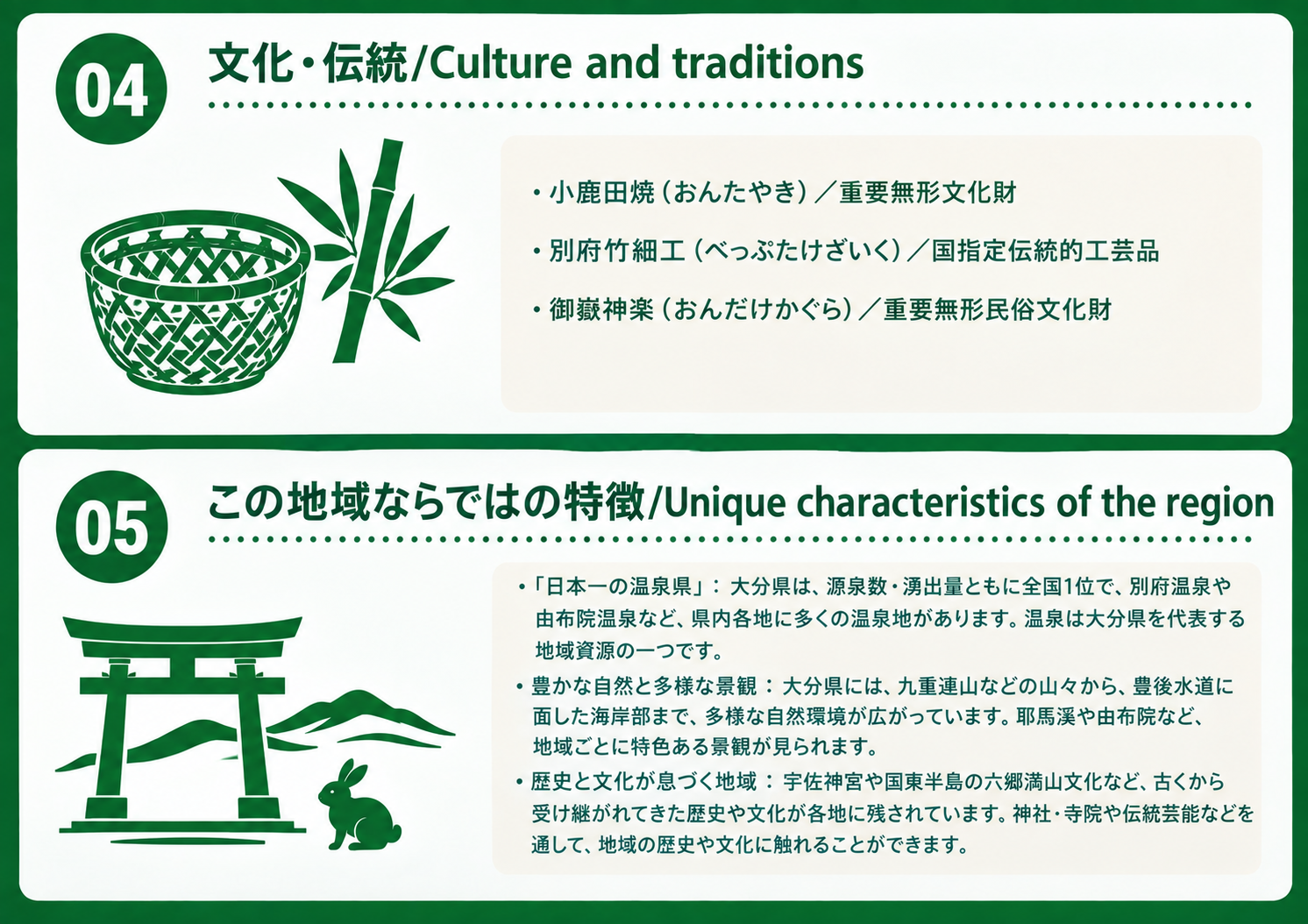
・ 小鹿田焼(おんたやき) / Ontayaki Pottery : Important Intangible Cultural Property
・ 別府竹細工(べっぷたけざいく) / Beppu Bamboo Craft : Nationally Designated Traditional Craft
・ 御嶽神楽(おんだけかぐら)/ Ondake Kagura : Important Intangible Folk Cultural Property
05:この地域ならではの特徴/Unique characteristics of the region
• “Japan’s No. 1 Hot Spring Prefecture”:
Oita Prefecture ranks first in Japan in both the number of hot spring sources and the volume of water they produce. The prefecture is home to many hot spring resorts throughout the region, including Beppu Onsen and Yufuin Onsen. Hot springs are one of Oita Prefecture’s most representative regional resources.
• Abundant Nature and Diverse Landscapes:
Oita Prefecture has a diverse natural environment, ranging from mountains such as the Kuju Mountain Range to the coastal areas along the Bungo Channel. Each region offers distinctive landscapes, including Yabakei and Yufuin.
・A Region Where History and Culture Thrive:
History and culture that have been passed down since ancient times can be found throughout the prefecture, including Usa Jingu Shrine and the Rokugo-Manzan culture of the Kunisaki Peninsula. Through shrines, temples, and traditional performing arts, visitors can experience the history and culture of each region.
06:世界とのつながり・異文化比較/Global connections and cross-cultural comparisons
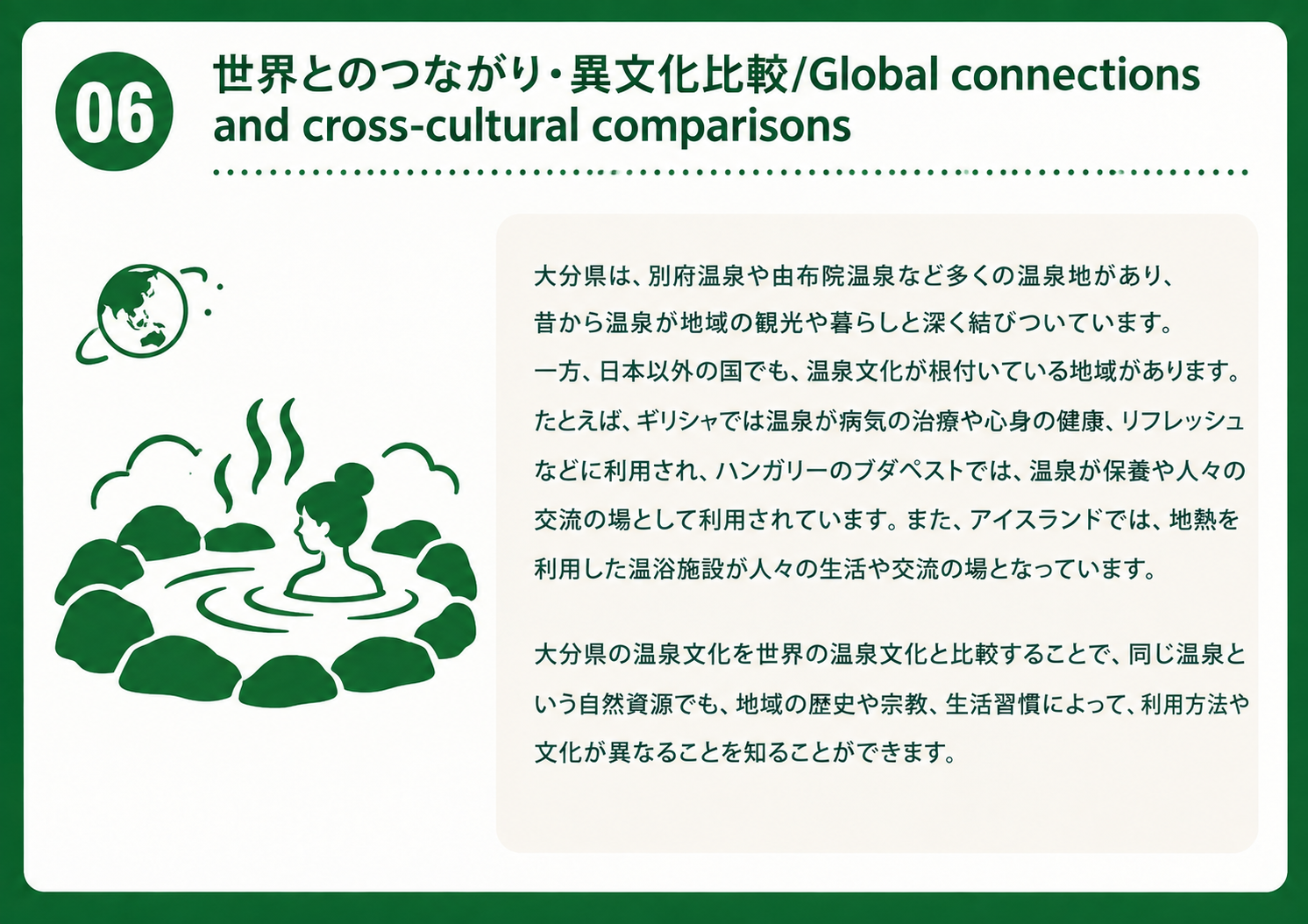
Oita Prefecture is home to many hot spring resorts, such as Beppu Onsen and Yufuin Onsen, and hot springs have long been deeply connected to the region’s tourism and daily life. Meanwhile, there are also regions outside Japan where hot spring culture has also taken root. For example, in Greece, hot springs are used for treating illnesses, promoting physical and mental well-being, and refresh the body and mind. In Budapest, Hungary, hot springs are used for recuperation and as places for people to socialize. In Iceland, geothermal bathing facilities are used in people’s daily lives and serve as places for social interaction.
By comparing Oita Prefecture’s hot spring cultures around the world, we can see that even though hot springs are the same natural resource, their uses and cultures vary depending on the history, religion, and lifestyle of each region.
07:地域のマナー・ルール/Local manners and customs
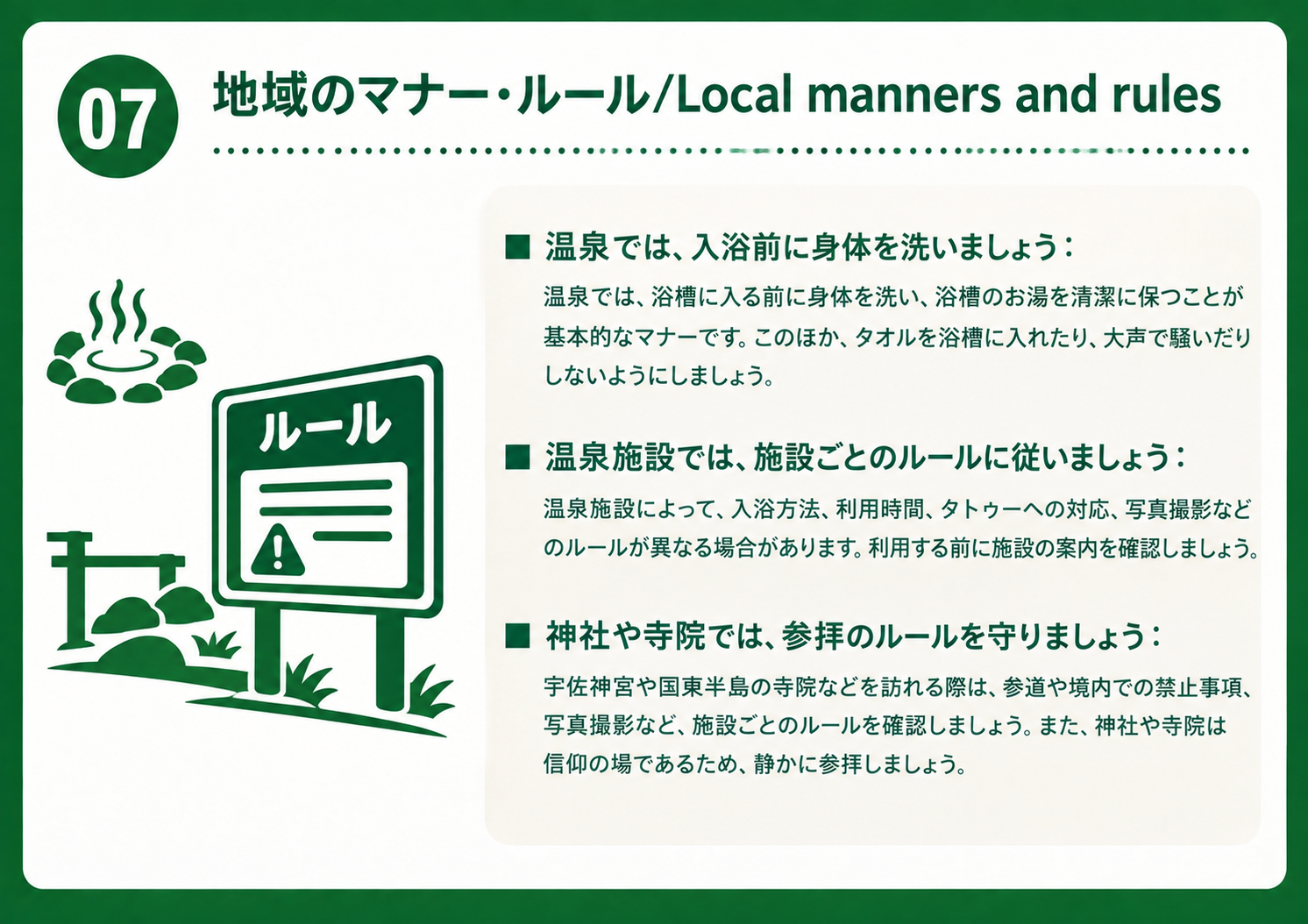
■ At hot springs, be sure to wash your body before entering the bath:
At hot springs, it is basic etiquette to wash yourself before entering the bath to help keep the bathwater clean. Also, please do not put towels in the bath or make loud noises.
■ At hot spring facilities, follow the rules of each facility:
Rules regarding bathing procedures, hours of use, tattoo policies, and photography may vary from one facility to another. Be sure to check the facility’s guidelines before using the facility.
■ At shrines and temples, observe the rules for worship:
When visiting places such as Usa Jingu or temples on the Kunisaki Peninsula, be sure to check the specific rules for each site, including prohibited activities on the approach paths and within the grounds, as well as rules regarding photography. Also, since shrines and temples are places of worship, please behave quietly and respectfully.
08:祭・伝統行事/Festivals and traditional events
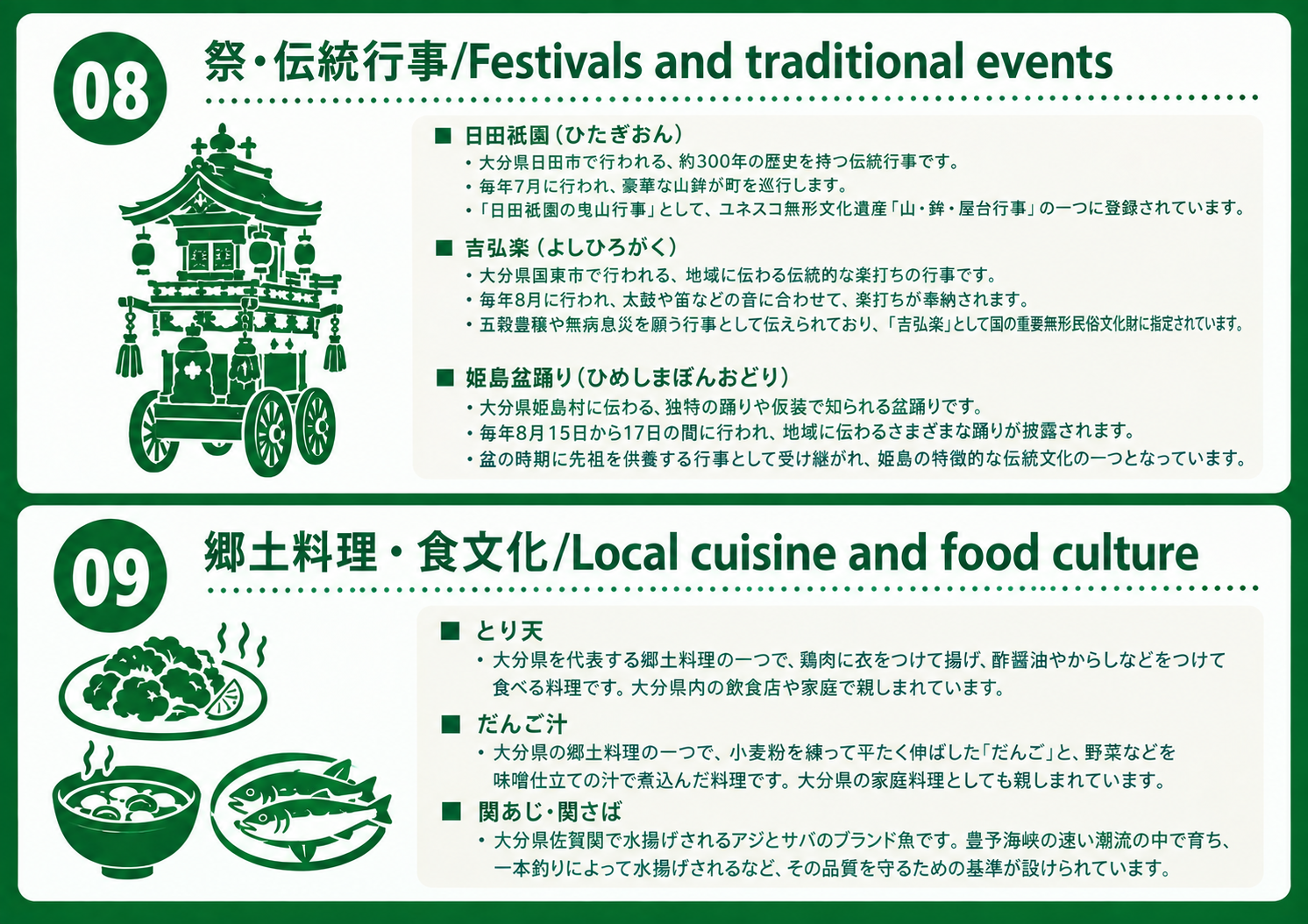
■ 日田祇園(ひたぎおん) / Hita Gion
・A traditional event with a history of approximately 300 years, held in Hita City, Oita Prefecture.
・It takes place every July, featuring a procession of magnificent floats through the town.
・Known as the “Hita Gion Float Procession,” it is registered as part of the UNESCO Intangible Cultural Heritage “Yama, Hoko, and Yatai Float Festivals.”
■ 吉弘楽(よしひろがく) / Yoshihirogaku
・A traditional musical event that has been passed down in the local community of Kunisaki City, Oita Prefecture.
・Held every August, it features performances accompanied by drums, flutes, and other instruments as an offering to the gods.
・It has been passed down as a traditional even to pray for a bountiful harvest and good health, and is designated as an Important Intangible Folk Cultural Property of Japan under the name “Yoshihirogaku.”
■ 姫島盆踊り(ひめしまぼんおどり) / Himeshima Bon Odori
・A Bon Odori festival passed down in Himeshima Village, Oita Prefecture, known for its unique dances and costumes.
・Held annually from August 15 to 17, the festival features various traditional dances that have been passed down in the local community.
・It has been passed down as a traditional event to honor ancestors during the Bon season and is one of Himeshima’s distinctive cultural traditions.
09:郷土料理・食文化/Local cuisine and food culture
■ とり天 / Toriten:
One of Oita Prefecture’s signature regional dishes, toriten is made by coating chicken in batter and deep-fried it. It is typically served with a dipping sauce made with vinegar and soy sauce or with mustard. It is popular at restaurants and in homes throughout Oita Prefecture.
■ だんご汁 / Dango-jiru:
One of Oita Prefecture’s traditional dishes, dango-jiru is a soup made with “dango,” flat pieces of dough made by kneading wheat flour, and vegetables simmered in a miso-based broth. It is also a popular home-cooked dish in Oita Prefecture.
■ 関あじ・関さば / Seki Horse Mackerel and Seki Mackerel:
These are branded varieties of horse mackerel and mackerel caught in Saganoseki, Oita Prefecture. They grow in the swift currents of the Bungo Channel and are caught using traditional single-line fishing methods. Strict standards are in place to ensure and maintain their quality.
10:公式情報・外国人向け情報/Official information and resources for international residents
■大分県公式ホームページ / Oita Prefecture Official Website
■おおいた国際交流プラザ / Oita International Exchange Plaza
■大分県「外国人住民のための防災情報」 / Oita Prefecture: “Disaster Prevention Information for Foreign Residents”
This article has been prepared by our staff based on official information provided by the Oita Prefectural Government, the Agency for Cultural Affairs, the Japan Tourism Agency, and other official sources. The information in this article is based on information available at time of publication. For the latest information, please refer to the relevant official websites.
クロスザボーダー編集部
日本在住の全ての外国人のために様々な有益な情報をまとめたサイトをオープンしました。アルバイトや就職情報はもちろんのこと、日本での生活の安定・安心・安全に繋がる基盤情報や、より日本での生活を充実してもらうようための様々な情報を提供しております。一つでも多くの有益な情報を提供することで、皆さんの選択肢が増え、より豊かな日本での生活を送ってもらうことをサポートいたします。
https://www.crosstheborder.biz/