01:宮崎県とは?/Introduction
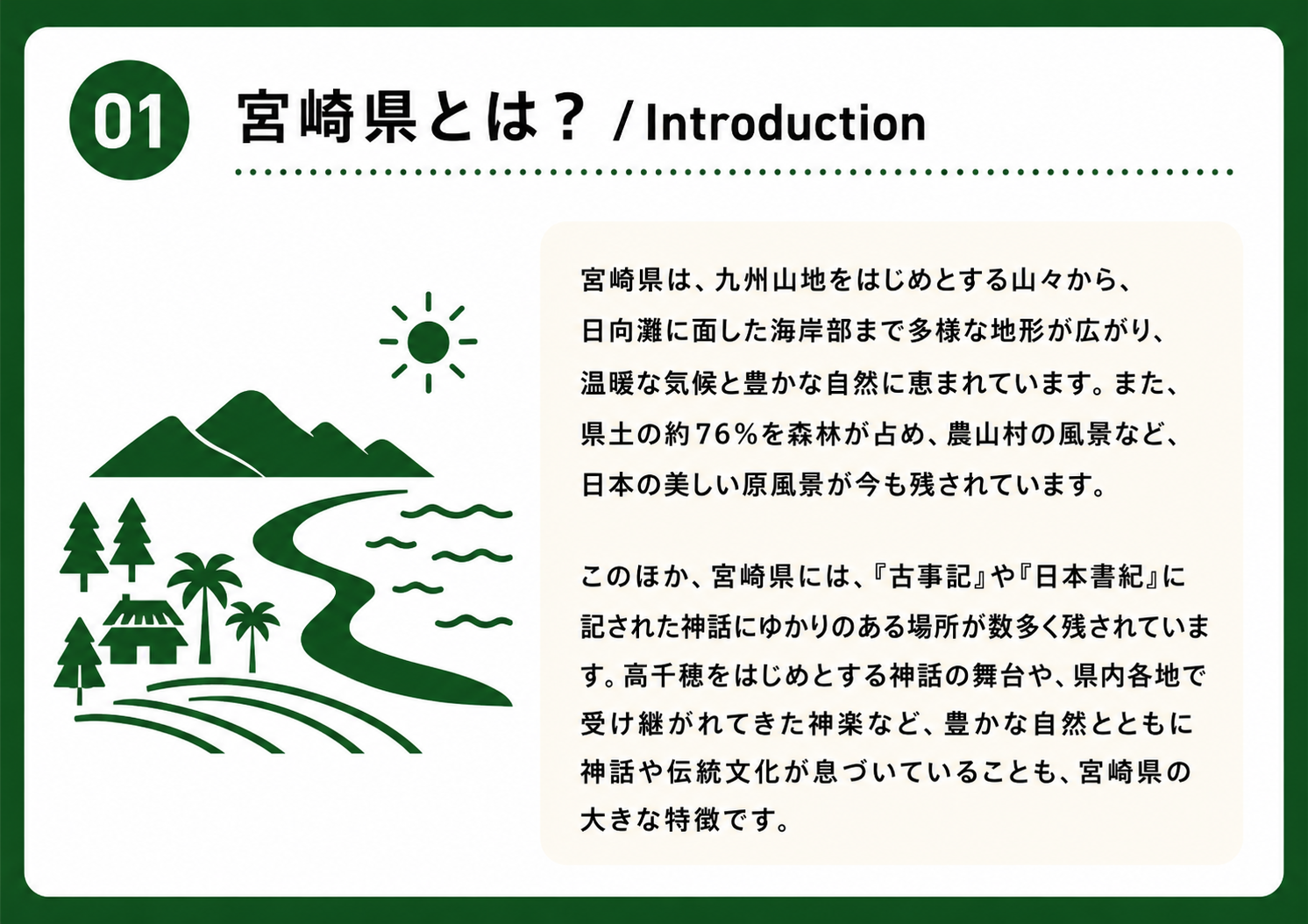
Miyazaki Prefecture boasts a diverse topography ranging from the mountains of the Kyushu Mountains Range to the coastline facing the Hyuga Sea, and is blessed with a mild climate and abundant natural beauty. Furthermore, forests cover approximately 76% of the prefecture’s land area, and Japan’s beautiful, traditional landscapes—such as those of rural and mountain villages—can still be found today.
Furthermore, Miyazaki Prefecture is home to numerous sites associated with the myths recorded in the *Kojiki* and *Nihon Shoki*. A major characteristic of Miyazaki Prefecture is that myths and traditional culture thrive alongside its rich natural environment, as seen in mythical settings such as Takachiho and the *kagura* rituals that have been passed down throughout the prefecture.
02:地理・基本情報/Geography
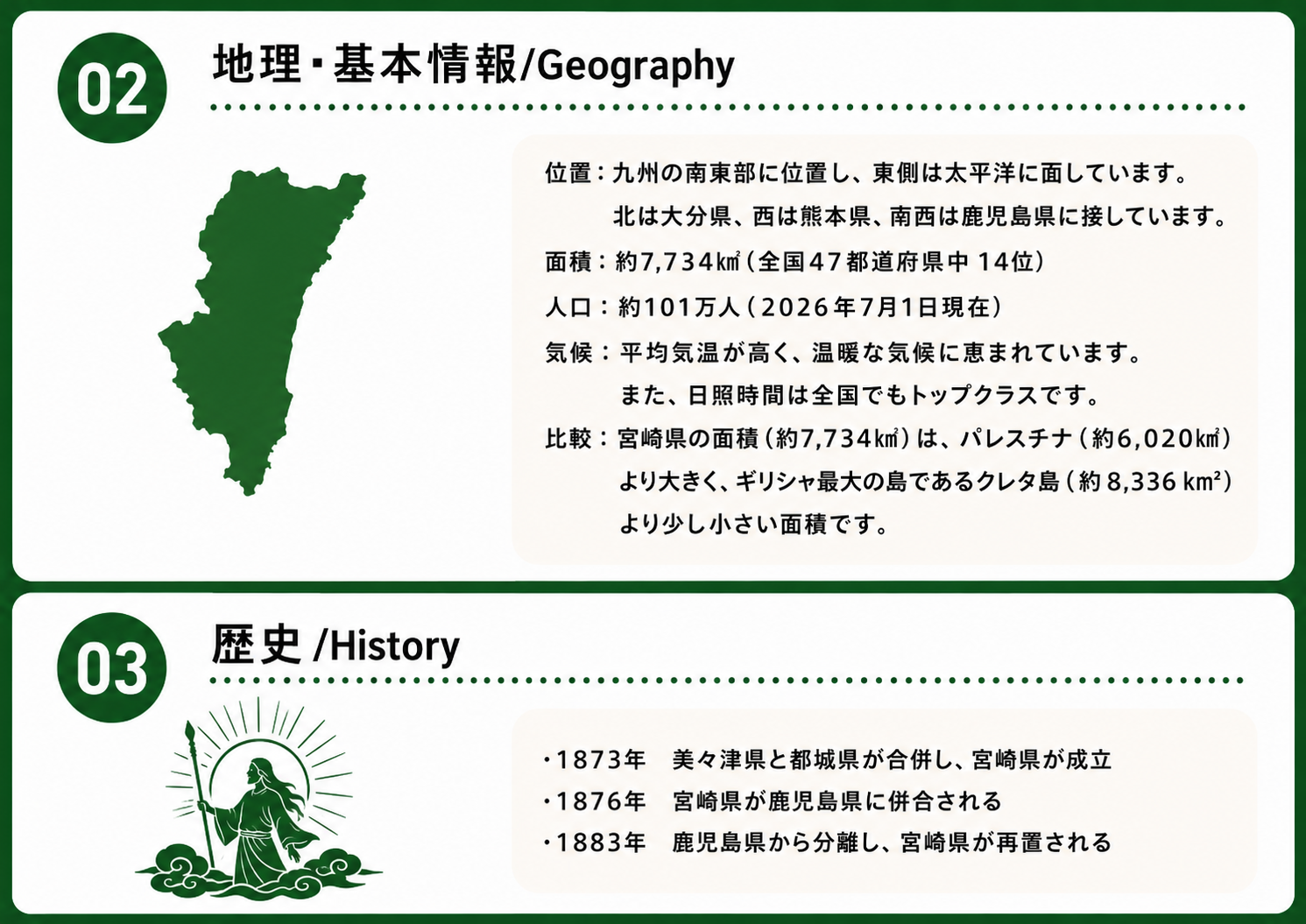
・ Location: Located in the southeastern part of Kyushu, the prefecture faces the Pacific Ocean to the east. It borders Oita Prefecture to the north, Kumamoto Prefecture to the west, and Kagoshima Prefecture to the southwest.
・ Area: Approximately 7,734 km² (14th among Japan’s 47 prefectures)
・ Population: Approximately 1.01 million (as of July 1, 2026)
・ Climate: The prefecture enjoys a warm climate with high average temperatures. It also ranks among the top in the country for hours of sunshine.
・Size Comparison: Miyazaki Prefecture’s area (approximately 7,734 km²) is larger than that of Palestine (approximately 6,020 km²) and slightly smaller than that of Crete (approximately 8,336 km²), Greece’s largest island.
03:歴史/History
・1873: Mimitsu Prefecture and Miyakonojo Prefecture merged to form Miyazaki Prefecture.
・1876: Miyazaki Prefecture was annexed by Kagoshima Prefecture.
・1883: Miyazaki Prefecture was reestablished after being separated from Kagoshima Prefecture.
For more information about the history of Miyazaki, please refer to the Historical Overview on the official Miyazaki Prefectural Government webpage.
04:文化・伝統/Culture and traditions
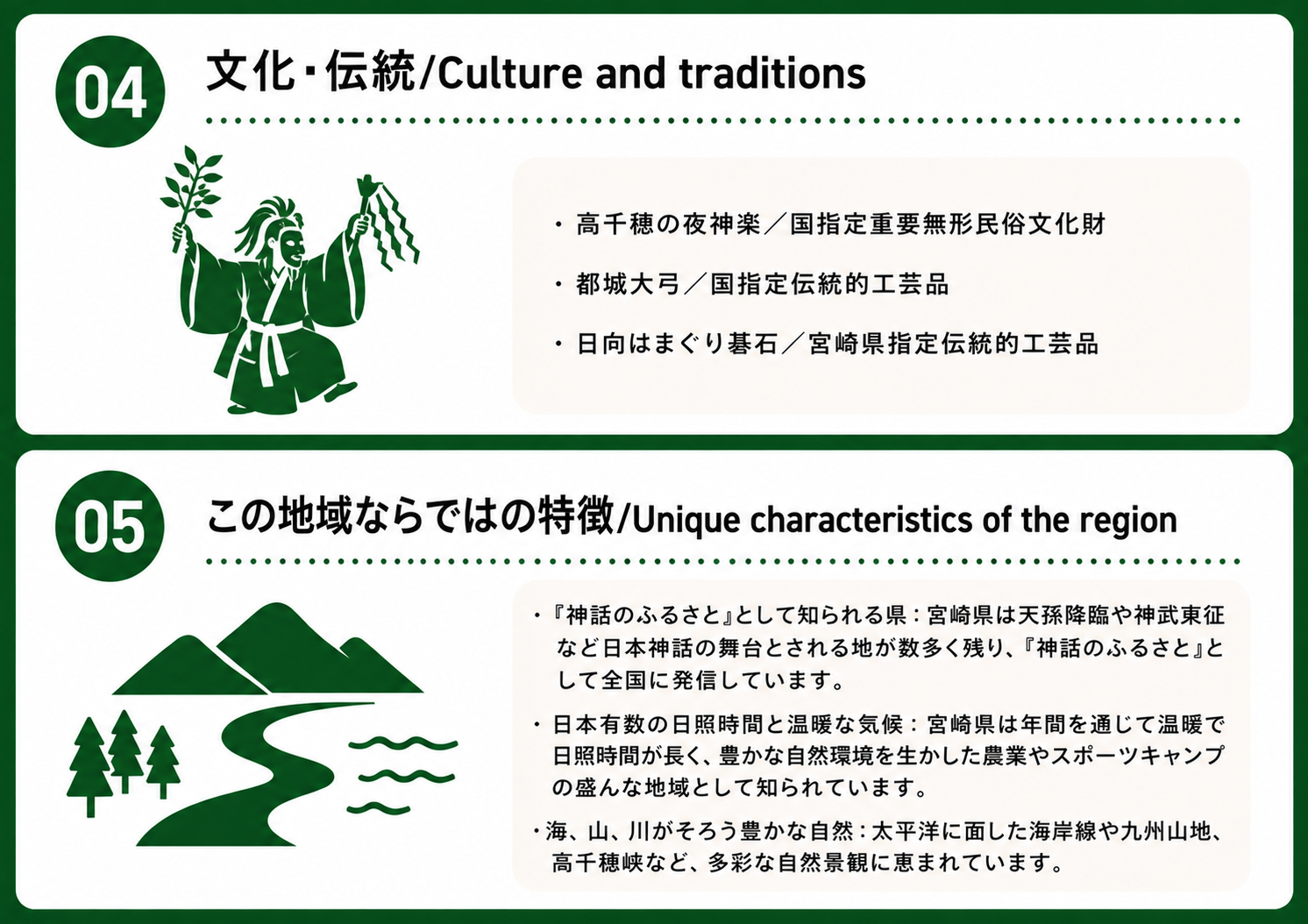
・ 高千穂の夜神楽 / Takachiho Night Kagura : Nationally Designated Important Intangible Folk Cultural Property
・ 都城大弓 / Miyakonojo O-Yumi : Nationally Designated Traditional Craft
・ 日向はまぐり碁石 / Hyuga Clam Go Stones : Miyazaki Prefecture-Designated Traditional Craft
05:この地域ならではの特徴/Unique characteristics of the region
・ A prefecture known as the “Home of Myths”:
Miyazaki Prefecture is home to numerous sites believed to be the settings for Japanese myths, such as the Descent of the Heavenly Grandchild and Emperor Jimmu’s Eastern Campaign, and promotes itself nationwide as the “Home of Myths.”
・ Among Japan’s sunniest region with a mild climate:
Miyazaki Prefecture enjoys a mild climate and abundant sunshine throughout the year, and is known as a region where agriculture and sports camps thrive, taking full advantage of its rich natural environment.
・ Abundant nature featuring the sea, mountains, and rivers:
The prefecture is blessed with diverse natural landscapes, including a coastline facing the Pacific Ocean, the Kyushu Mountains, and Takachiho Gorge.
06:世界とのつながり・異文化比較/Global connections and cross-cultural comparisons
The myths and kagura that remain in Miyazaki Prefecture have been passed down as part of Japanese culture, but cultures around the world have also conveyed their regional history, nature, and way of life through myths, legends, traditional dance, and music. For example, myths from around the world—such as Greek and Norse mythology—contain numerous stories linked to natural phenomena, the formation of the land, and people’s daily lives.
Furthermore, traditional cultures that express stories about deities and ancestors through music and dance—much like Kagura—can be found all over the world. Learning about the myths and Kagura of Miyazaki Prefecture not only deepens your understanding of Japanese culture but also provides an opportunity to reflect on how these cultures have been passed down by comparing them with the myths, traditional performing arts, and festivals that remain in your own country or region.
07:地域のマナー・ルール/Local manners and customs
■ Approach Kagura not as a “spectator” but with the mindset of “participating in a sacred ritual”:
Kagura is a sacred ritual in which local people become one with the gods. Therefore, visitors should attend with the mindset that they are honored to participate.
■ At Kagura venues, please follow the local “customs” of each region:
At the Takachiho Night Kagura, each region and village has its own rules regarding entering the sacred grounds, taking photographs, and the use of flash, tripods, and cell phones. If you plan to attend, please check with the tourist information center or similar office in advance.
■ In agricultural areas, please do not enter farmland or farm roads without permission:
Miyazaki is a prefecture with a thriving agricultural sector, and its rural and mountainous landscapes are one of its defining features. Please refrain from entering farmland or farm roads without permission to take photographs or otherwise interfering with farm work.
08:祭・伝統行事/Festivals and traditional events
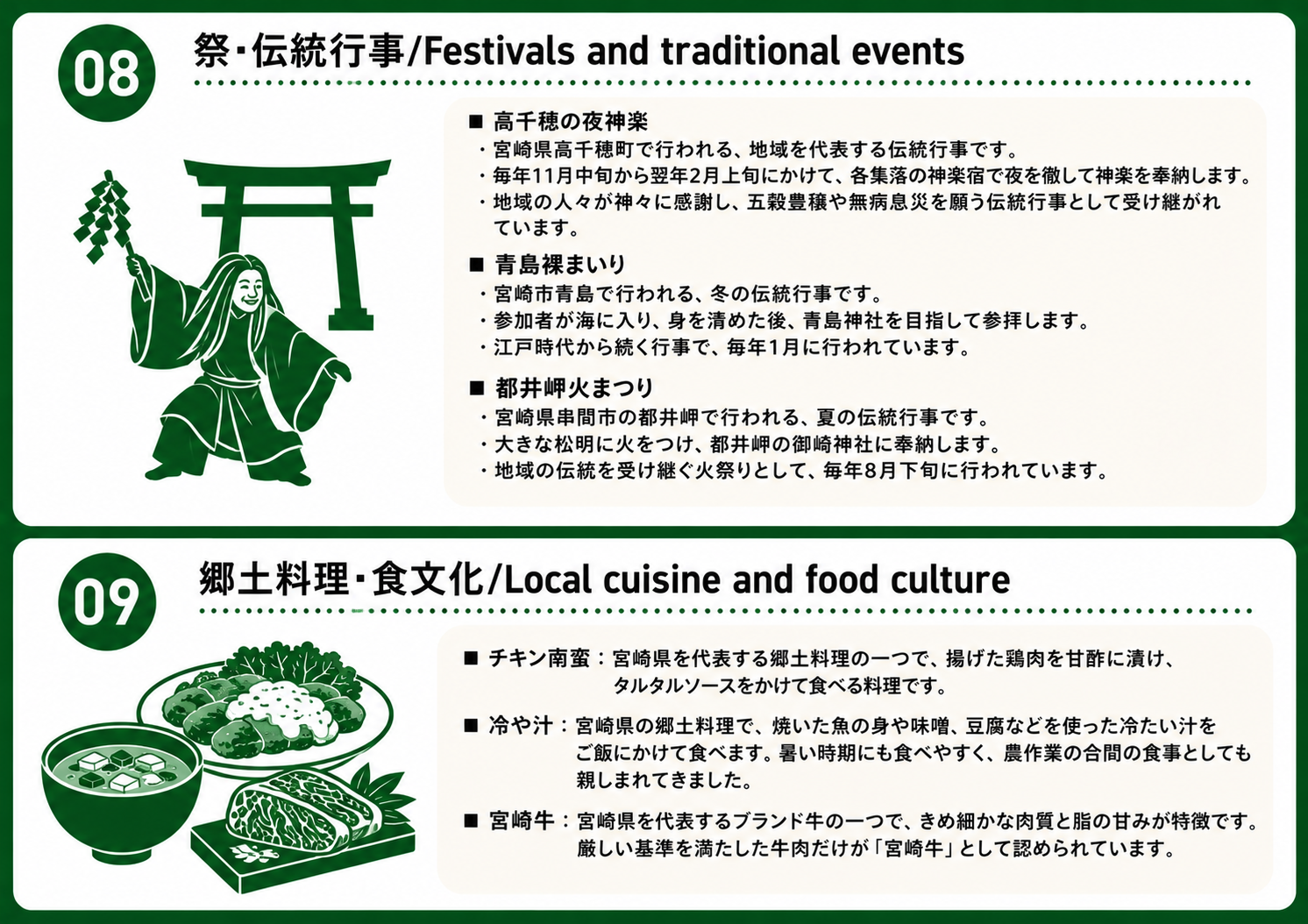
■ 高千穂の夜神楽 / Takachiho Night Kagura
・This is a traditional event that representst the region, held in Takachiho Town, Miyazaki Prefecture.
・Every year from mid-November to early February, Kagura performances are dedicated throughout the night at Kagura lodgings in each village.
・It has been passed down as a traditional event in which local people express their gratitude to the gods and pray for a bountiful harvest and good health.
■ 青島裸まいり / Aoshima Hadaka Mairi
・A traditional winter event held on Aoshima in Miyazaki City.
・Participants enter the sea to purify themselves, then proceed to Aoshima Shrine to pray.
・This event, which has been held every January since the Edo period, continues to this day.
■ 都井岬火まつり / Cape Toi Fire Festival
・This is a traditional summer event held at Cape Toi in Kushima City, Miyazaki Prefecture.
・Large torches are lit and offered at Misaki Shrine on Cape Toi.
・As a fire festival that carries on local traditions, it is held every year in late August.
09:郷土料理・食文化/Local cuisine and food culture
■ チキン南蛮 / Chicken Nanban:
One of Miyazaki Prefecture’s signature regional dishes, it consists of deep-fried chicken marinated in a sweet and sour sauce and served with tartar sauce.
■ 冷や汁 / Hiyajiru:
A regional dish from Miyazaki Prefecture, it is a cold soup made with grilled fish, miso, tofu, and other ingredients, served over rice. It is easy to eat even during hot weather and has long been a popular meal enjoyed during breaks from farm work.
■ 宮崎牛 / Miyazaki Beef:
One of Miyazaki Prefecture’s leading brands of beef, characterized by its fine-grained texture and the sweetness of its fat. Only beef that meets strict standards is certified as “Miyazaki Beef.”
10:公式情報・外国人向け情報/Official information and resources for international residents
■宮崎県公式ホームページ / Miyazaki Prefecture Official Website
■みやざき外国人サポートセンター / Miyazaki Foreign Residents Support Center
■宮崎県国際交流協会 / Miyazaki Prefecture International Exchange Association
■宮崎県「外国人住民のための防災パンフレット」 / Miyazaki Prefecture “Disaster Prevention Pamphlet for Foreign Residents”
■宮崎県防災・危機管理情報 / Miyazaki Prefecture Disaster Prevention and Crisis Management Information
This article has been prepared by our staff based on official information provided by the Miyazaki Prefectural Government, the Agency for Cultural Affairs, the Japan Tourism Agency, and other official sources. The information in this article is based on information available at time of publication. For the latest information, please refer to the relevant official websites.
クロスザボーダー編集部
日本在住の全ての外国人のために様々な有益な情報をまとめたサイトをオープンしました。アルバイトや就職情報はもちろんのこと、日本での生活の安定・安心・安全に繋がる基盤情報や、より日本での生活を充実してもらうようための様々な情報を提供しております。一つでも多くの有益な情報を提供することで、皆さんの選択肢が増え、より豊かな日本での生活を送ってもらうことをサポートいたします。
https://www.crosstheborder.biz/