01:熊本県とは?/Introduction
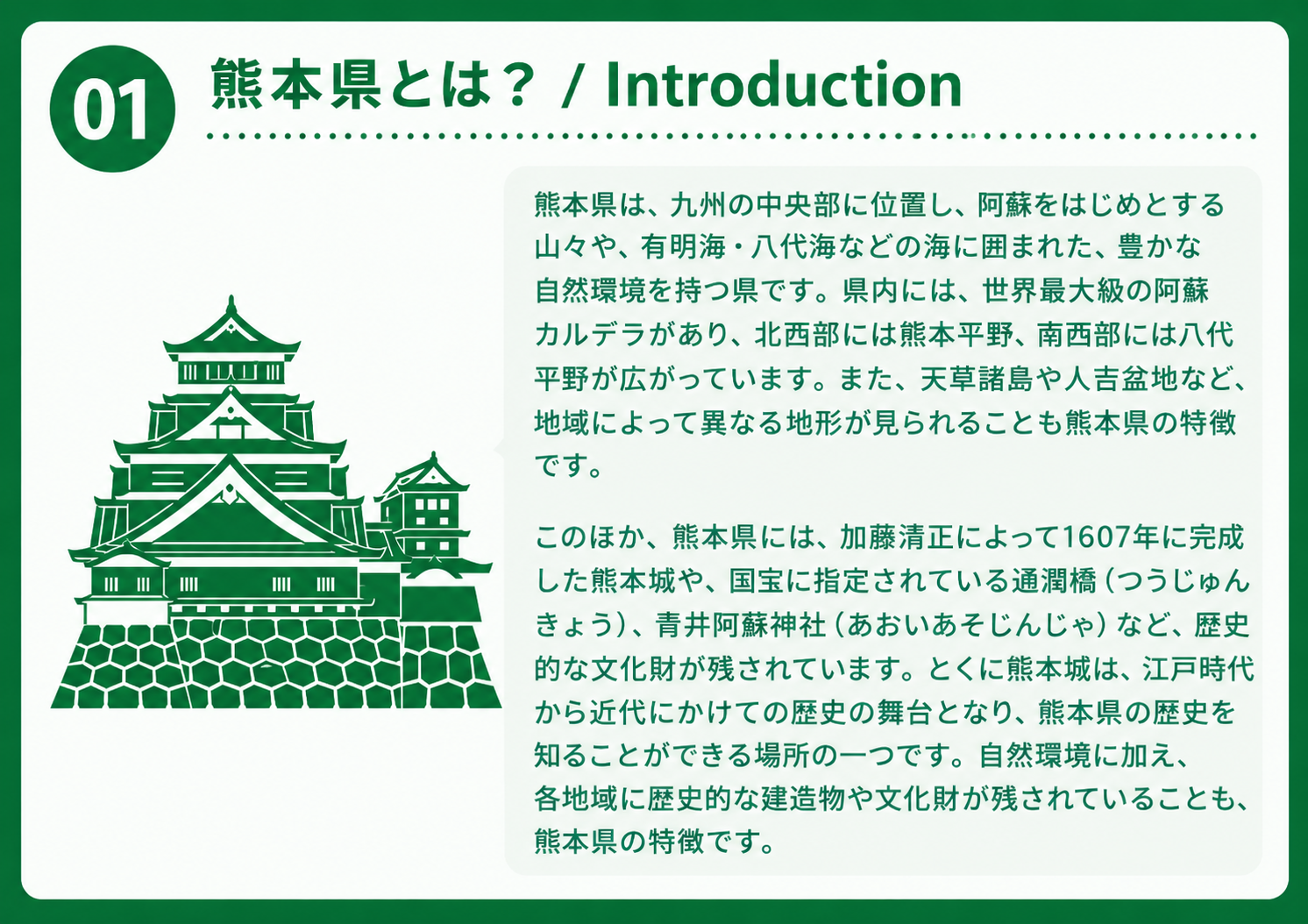
Kumamoto Prefecture is located in the central part of Kyushu and is blessed with a rich natural environment, surrounded by mountains—including Mount Aso—and bodies of water such as the Ariake Sea and the Yatsushiro Sea. The prefecture is home to the Aso Caldera, one of the largest calderas in the world, with the Kumamoto Plain extending across the northwestern part of the prefecture and the Yatsushiro Plain in the southwest. Another characteristic of Kumamoto Prefecture is its diverse landscape, which varies from region to region, including the Amakusa Islands and the Hitoyoshi Basin.
Kumamoto Prefecture is also home to many historical and cultural sites, including Kumamoto Castle, completed in 1607 by Kato Kiyomasa; the Tsujun Bridge, designated as a National Treasure; and Aoi Aso Shrine. Kumamoto Castle, in particular, played an important role in the history of the region from the Edo period through the modern era and is one of the places where visitors can learn about the history of Kumamoto Prefecture. In addition to its rich natural environment, another defining feature of Kumamoto Prefecture is the many historical structures and cultural properties that have been preserved throughout the region.
02:地理・基本情報/Geography
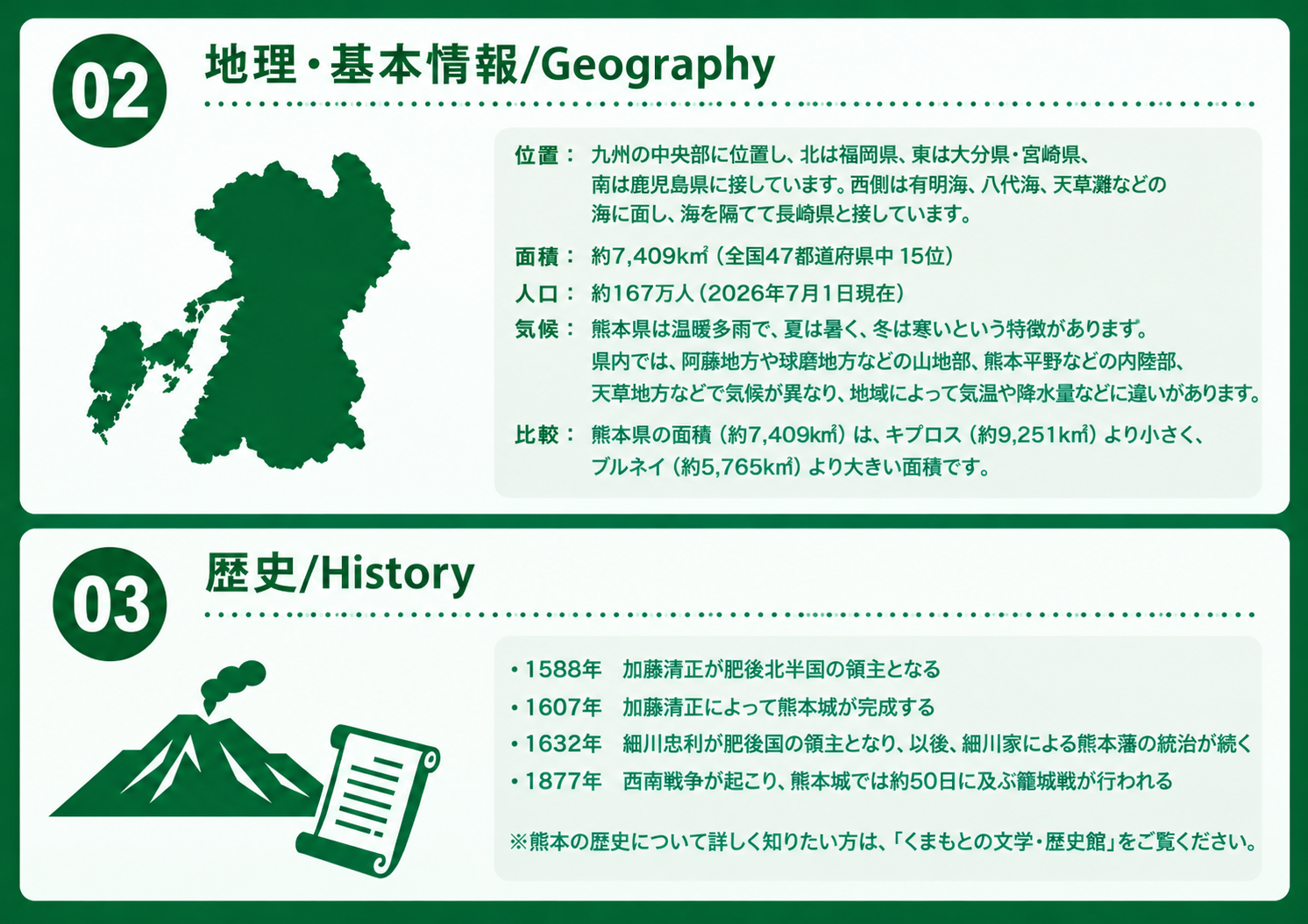
・ Location: Kumamoto Prefecture is located in central Kyushu. It borders Fukuoka Prefecture to the north, Oita and Miyazaki Prefectures to the east, and Kagoshima Prefecture to the south. To the west, it faces the Ariake Sea, the Yatsushiro Sea, and the Amakusa-nada Sea, and Nagasaki Prefecture lies across the sea.
・ Area: Approximately 7,409 km² (15th largest among Japan’s 47 prefectures)
・ Population: Approximately 1.67 million (as of July 1, 2026)
・ Climate: Kumamoto Prefecture has a warm and rainy climate, characterized by hot summers and cold winters. The climate varies across the prefecture, including mountainous regions such as the Aso and Kuma regions, inland areas such as the Kumamoto Plain, and the Amakusa region. As a result, temperatures and precipitation levels differ from one area to another.
・Comparison: Kumamoto Prefecture covers approximately 7,409 km², making it smaller than Cyprus (approximately 9,251 km²) but larger than Brunei (approximately 5,765 km²).
03:歴史/History
・1588: Kato Kiyomasa became the lord of the northern half of Higo Province.
・1607: Kumamoto Castle was completed by Kato Kiyomasa.
・1632: Hosokawa Tadatoshi became the lord of Higo Province, and the Hosokawa family continued to rule the Kumamoto Domain thereafter.
・1877: The Satsuma Rebellion, also known as the Sinan War, broke out, and Kumamoto Castle endured a siege lasting more than 50 days.
*For those interested in learning more about the history of Kumamoto, please visit the “Kumamoto Museum of Literature and History.”
04:文化・伝統/Culture and traditions
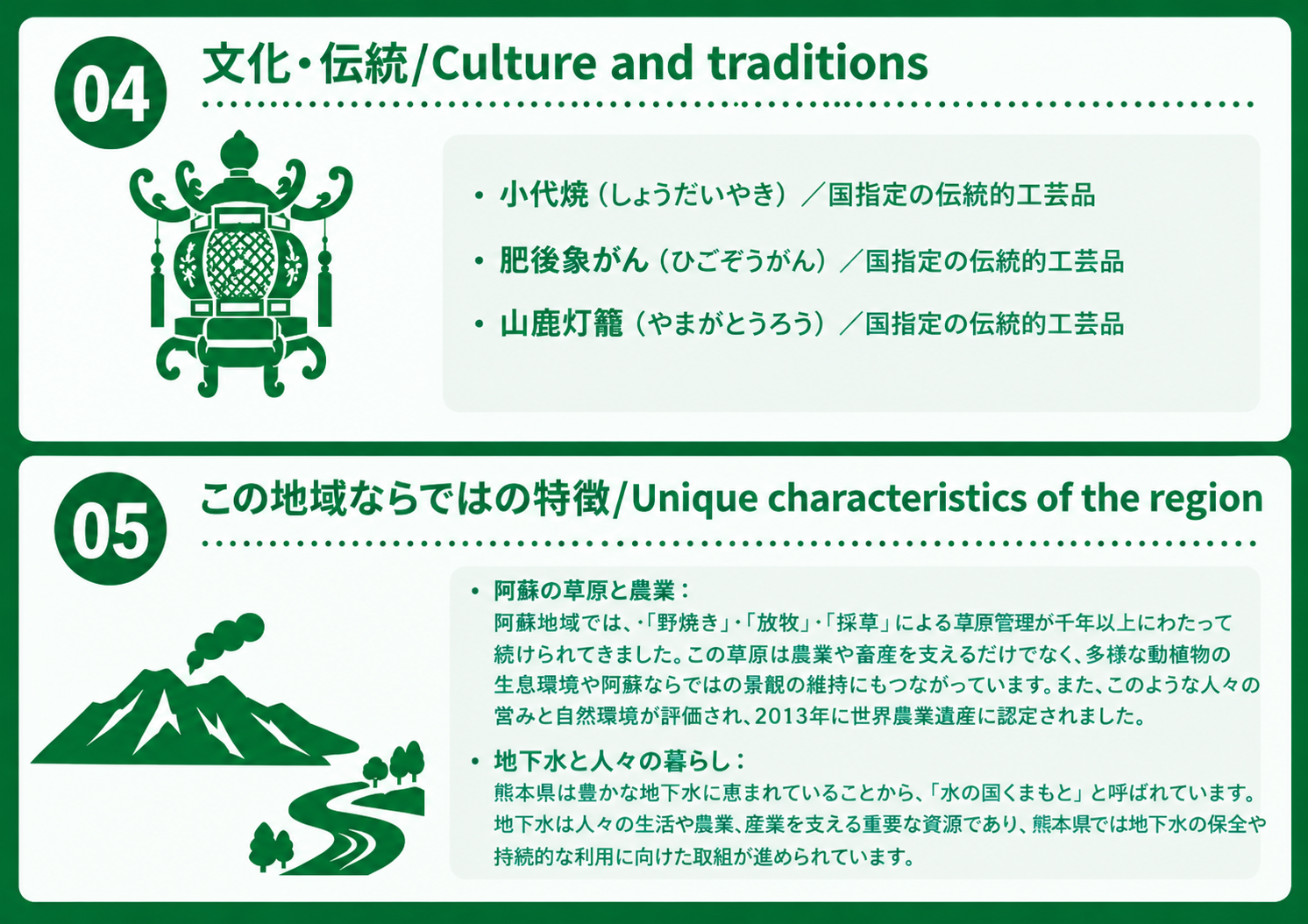
・ 小代焼(しょうだいやき) / Shōdai-Ware : Nationally Designated Traditional Craft
・ 肥後象がん(ひごぞうがん) / Higo Inlays : Nationally Designated Traditional Craft
・ 山鹿灯籠(やまがとうろう)/ Yamaga Tōrō : Nationally Designated Traditional Craft
05:この地域ならではの特徴/Unique characteristics of the region
・Aso’s Grasslands and Agriculture:
In the Aso region, grassland management through “controlled burning,” “grazing,” and “hay harvesting” has been practiced for more than 1,000 years. These grasslands not only support agriculture and livestock farming but also provide habitats for a diverse range of plants and animals and help preserve Aso’s unique landscape. In recognition of these long-standing practices and the natural environment they have helped maintain, the region was designated as a Globally Important Agricultural Heritage System (GIAHS) in 2013.
・Groundwater and People’s Lives:
Kumamoto Prefecture is blessed with abundant groundwater and is known as “Kumamoto, the Land of Water.” Groundwater is a vital resource that supports people’s daily lives, agriculture, and industry. The prefecture is actively working to conserve its groundwater resources and promote their sustainable use.
06:世界とのつながり・異文化比較/Global connections and cross-cultural comparisons
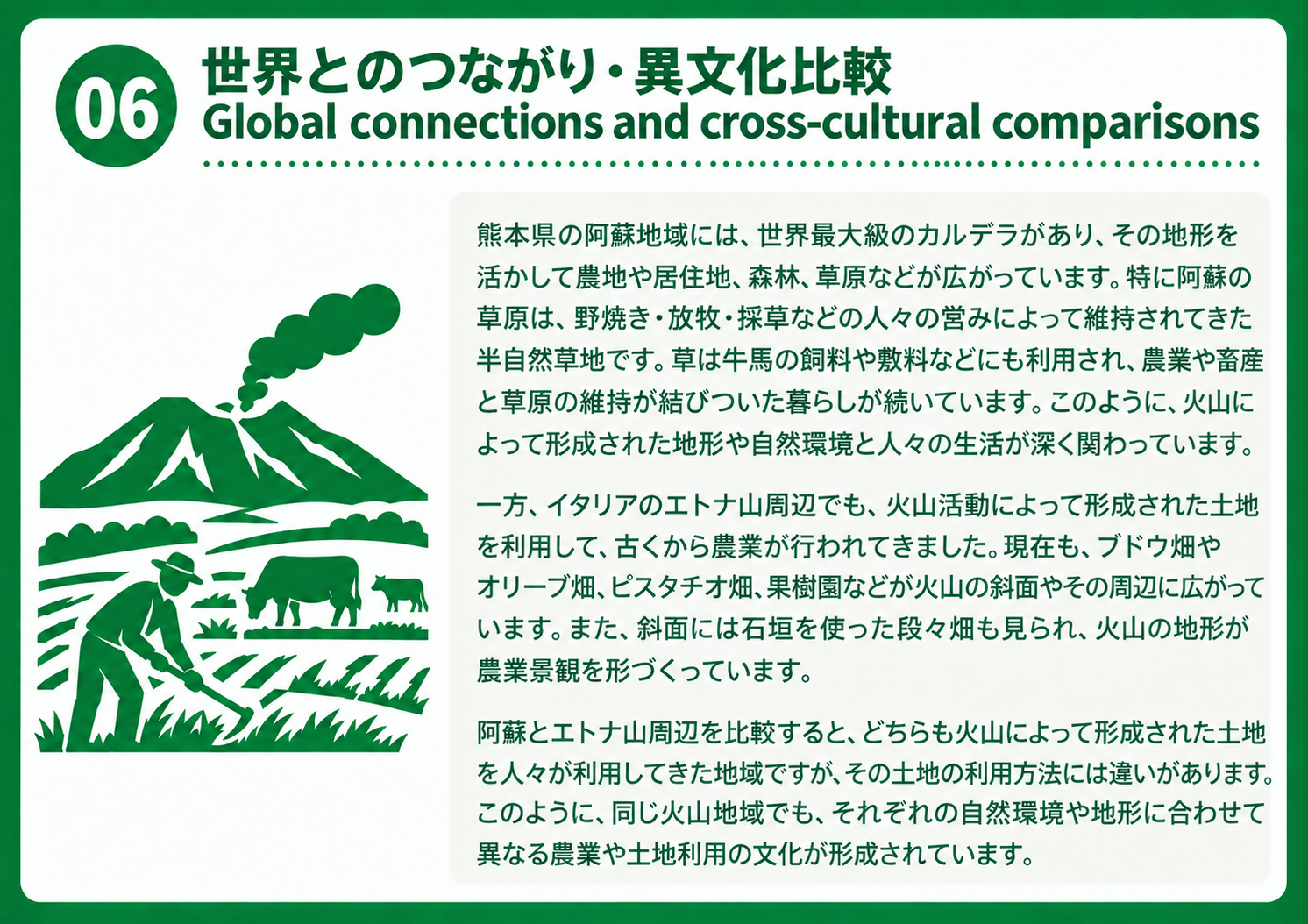
The Aso region in Kumamoto Prefecture is home to one of the world’s largest calderas, and its volcanic landscape is home to farmland, residential areas, forests, and grasslands. In particular, the Aso grasslands are semi-natural grasslands that have been maintained through long-standing human practices such as controlled burning, grazing, and hay harvesting. The grass is used as feed and bedding for cattle and horses, and a way of life that connects agriculture, livestock farming, and grassland maintenance continues to this day. In this way, the volcanic topography and natural environment are deeply connected to the lives of local people.
Meanwhile, in the area surrounding Mount Etna in Italy, agriculture has been practiced since ancient times on land shaped by volcanic activity. Even today, vineyards, olive groves, pistachio orchards, and fruit orchards can be found across the volcanic slopes and surrounding areas. Terraced fields supported by stone walls can also be seen on the slopes, with the volcanic terrain shaping the agricultural landscape.
Comparing the Aso region with the area around Mount Etna, both are regions where people have made use of land shaped by volcanic activity, but the way in which the land is used differs. This shows that even in volcanic regions with similar characteristics, distinct agricultural and land-use cultures have developed in response to their respective natural environments and topography.
07:地域のマナー・ルール/Local manners and customs
■ Please do not enter the Aso grasslands without permission:
Some areas of the Aso grasslands are managed by local grazing associations and other organizations. When entering the grasslands, please follow your guide’s instructions and do not enter areas without permission. To help prevent the spread of livestock diseases, please also follow the established rules, such as disinfecting yourself and your belongings before entering.
■ Please be considerate of residents’ daily lives in the Sakitsu Village, a World Cultural Heritage Site:
Residents still live in Sakitsu Village today. When visiting, please avoid blocking the roads and observe the area quietly so as not to disturb the daily lives of local residents. Sakitsu Church is a place of worship, so visitors are asked not to make noise inside or outside the church and to refrain from visiting when religious ceremonies are taking place.
■ Prepare for disasters by checking local disaster prevention information:
Kumamoto Prefecture provides disaster prevention information in lifestyle guidebooks for foreign residents to help them prepare for disasters such as earthquakes and heavy rain. Be sure to check in advance the evacuation sites and emergency contact information for your area.
08:祭・伝統行事/Festivals and traditional events
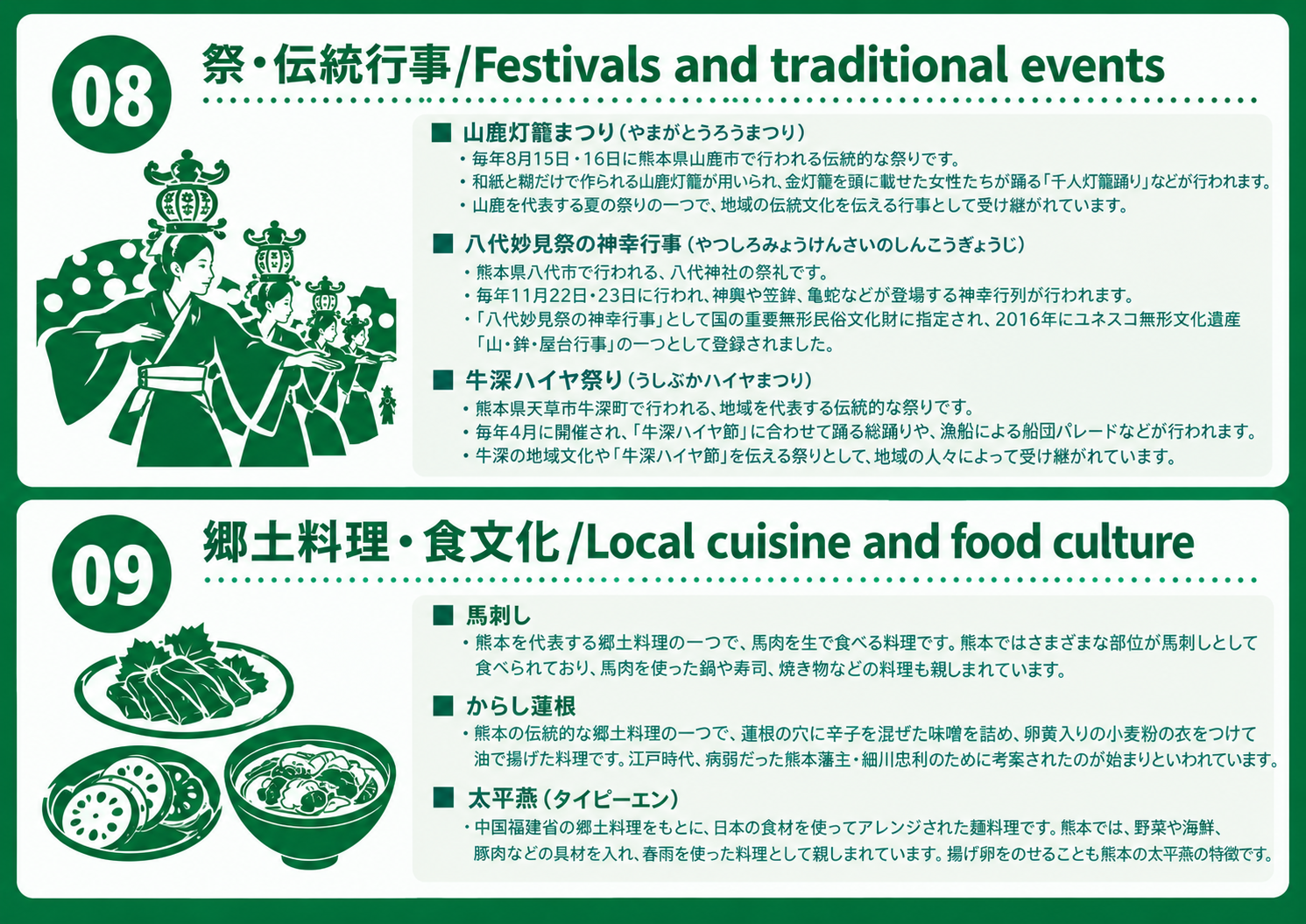
■ 山鹿灯籠まつり(やまがとうろうまつり) / Yamaga Lantern Festival (Yamaga Tōrō Matsuri)
・This traditional festival is held every year on August 15 and 16 in Yamaga City, Kumamoto Prefecture.
・The festival features Yamaga lanterns made entirely from washi paper and glue, as well as events such as the “Thousand-Lantern Dance,” in which women dance while balancing golden lanterns on their heads.
・It is one of Yamaga’s major summer festivals and has been passed down through generations as an important event for preserving the region’s traditional culture.
■ 八代妙見祭の神幸行事(やつしろみょうけんさいのしんこうぎょうじ) / Yatsushiro Myoken Festival Procession (Yatsushiro Myoken-sai no Shinkō Gyōji)
・This is a traditional festival procession held as part of annual festival of Yatsushiro Shrine in Yatsushiro City, Kumamoto Prefecture.
・Held annually on November 22 and 23, it features a procession of portable shrines (mikoshi), kasaboko floats, and kame-ja (turtle-snake floats).
・“Yatsushiro Myoken Festival Procession” has been designated as an Important Intangible Folk Cultural Property of Japan. In 2016, it was inscribed on UNESCO’s Representative List of the Intangible Cultural Heritage of Humanity as part of the “Yama, Hako, Yatai Festivals.”
■ 牛深ハイヤ祭り(うしぶかハイヤまつり) / Ushibuka Haiya Festival
・This is a traditional festival that represens the local culture of Ushibuka, held in Ushibuka Town, Amakusa City, Kumamoto Prefecture.
・Held every April, the festival features a large group dance performed to the “Ushibuka Haiya-bushi,” as well as a parade of fishing boats.
・The festival has been passed down by the local community as an important event for preserving Ushibuka’s local culture and the tradition of “Ushibuka Haiya-bushi.”
09:郷土料理・食文化/Local cuisine and food culture
■ 馬刺し / Basashi:
One of Kumamoto’s signature regional dishes, basashi is a dish made from raw horse meat. In Kumamoto, various cuts of horse meat are enjoyed as basashi, and other horse meat dishes, such as hot pots, sushi, and grilled dishes, are also popular.
■ からし蓮根 / Karashi Renkon:
One of Kumamoto’s traditional regional dishes, karashi renkon is made by stuffing the holes of lotus root with a mixture of mustard and miso, coating it with a batter made from flour and egg yolk, and deep-frying it. It is said to have originated during the Edo period, when it was created for Hosokawa Tadatoshi, the lord of the Kumamoto domain, who was in poor health.
■ 太平燕(タイピーエン) / Taipingyan:
A noodle dish adapted from a regional dish from Fujian Province, China, using Japanese ingredients. In Kumamoto, it is enjoyed as a dish made with glass noodles and served with vegetables, seafood, pork, and other ingredients. Topping it with a fried egg is also a distinctive feature of Kumamoto-style Taipingyan.
10:公式情報・外国人向け情報/Official information and resources for international residents
■熊本県公式ホームページ /Kumamoto Prefecture Official Website
■外国人のための生活ガイドブック / Multilingual Living Guidebook for Foreigners in Kumamoto Prefecture
■外国人の皆様へ消費生活相談のご案内 / Consumer Affairs Counseling Information for Foreign Residents
■熊本市外国人総合相談プラザ / Kumamoto City Consultation and Support Plaza for Foreign Residents
This article has been prepared by our staff based on official information provided by the Kumamoto Prefectural Government, the Agency for Cultural Affairs, the Japan Tourism Agency, and other official sources. The information in this article is based on information available at time of publication. For the latest information, please refer to the relevant official websites.
クロスザボーダー編集部
日本在住の全ての外国人のために様々な有益な情報をまとめたサイトをオープンしました。アルバイトや就職情報はもちろんのこと、日本での生活の安定・安心・安全に繋がる基盤情報や、より日本での生活を充実してもらうようための様々な情報を提供しております。一つでも多くの有益な情報を提供することで、皆さんの選択肢が増え、より豊かな日本での生活を送ってもらうことをサポートいたします。
https://www.crosstheborder.biz/